Archimedes’ Mechanical Method

One of Archimedes’ remarkable ideas was to use mechanics to solve problems in geometry. Instead of finding the area or volume of a curved figure directly, he compared its cross-sections with those of simpler figures, such as triangles, cones, and cylinders. By arranging these sections to balance on a lever, he could determine an unknown area or volume from the known area or volume and center of gravity of a simpler figure. In The Method of Mechanical Theorems, addressed to Eratosthenes, Archimedes explained how such mechanical arguments could be used to discover geometric results. The central idea was to find suitable auxiliary figures whose sections satisfied the law of the lever. Archimedes worked with geometric proportions; we will use modern coordinates and algebra to reconstruct his arguments and understand how these auxiliary figures can be found.

The Law of the Lever: Two weights balance about a fulcrum when the product of weight and distance from the fulcrum is the same on both sides:

\displaystyle W_1d_1=W_2d_2.

A collection of weights can be replaced by a single weight equal to their sum, acting at their center of gravity. If weights w_i are placed at positions x_i , their center of gravity \bar{x} satisfies

\displaystyle \left(\sum_i w_i\right)\bar{x}=\sum_i w_ix_i.

For a uniform plate, weight is proportional to area. The center of gravity of a triangle is the intersection of its medians, whose coordinates are the averages of those of its vertices. Similarly, a uniform cylinder has its center of gravity at the midpoint of its axis. Thus, knowing the area or volume and center of gravity of a figure allows us to calculate its total moment without considering its individual parts.

Archimedes used this idea to find unknown areas and volumes. Suppose a curved region has vertical sections of length s(x) , and a familiar figure has sections of length t(x) . Place a fulcrum so that the section of the familiar figure at position x is at distance d(x) from it. Suppose we can find a fixed distance L such that

\displaystyle Ls(x)=d(x)t(x).

This means that the two sections balance if we leave the familiar section at its original position and move the section of the curved region to distance L on the opposite side. If this relation holds for every x , we can imagine moving all the sections of the curved region to the same fixed point. The entire curved region then balances the familiar figure. Since we know the area and center of gravity of the familiar figure, we can calculate its total moment and hence find the unknown area. The same reasoning applies to volumes, using cross-sectional areas instead of lengths.

The main idea is therefore to find a simpler figure whose sections, when multiplied by their distances from a suitable fulcrum, agree with the sections of the figure we want to measure.

Parabolic Segment

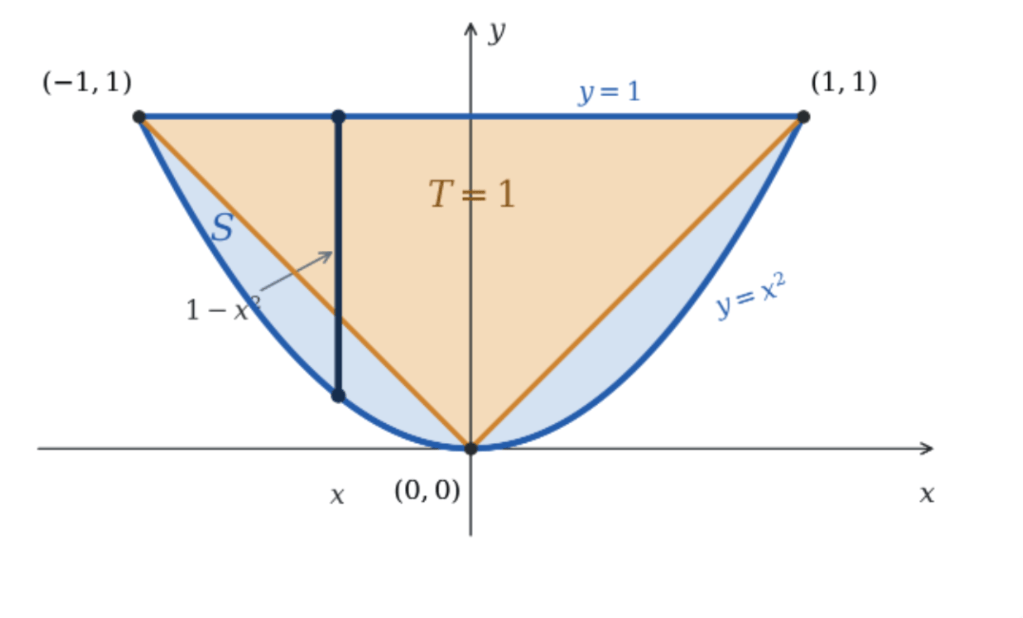
Consider the region bounded by y=x^2 and y=1 , for -1\leq x\leq1 . Let its area be S . The triangle with vertices (-1,1),(0,0),(1,1) lies inside this region. Its base is 2 and its height is 1, so its area is T=1 .

We want to show that the area of the parabolic segment is four-thirds that of this triangle:

\displaystyle S=\frac43T.

At each position x , the vertical section of the parabolic segment has length 1-x^2 . To apply the law of the lever, we want to express this length as the product of a distance from a fulcrum and the section length of some familiar figure. The factorization

\displaystyle 1-x^2=(1-x)(1+x)

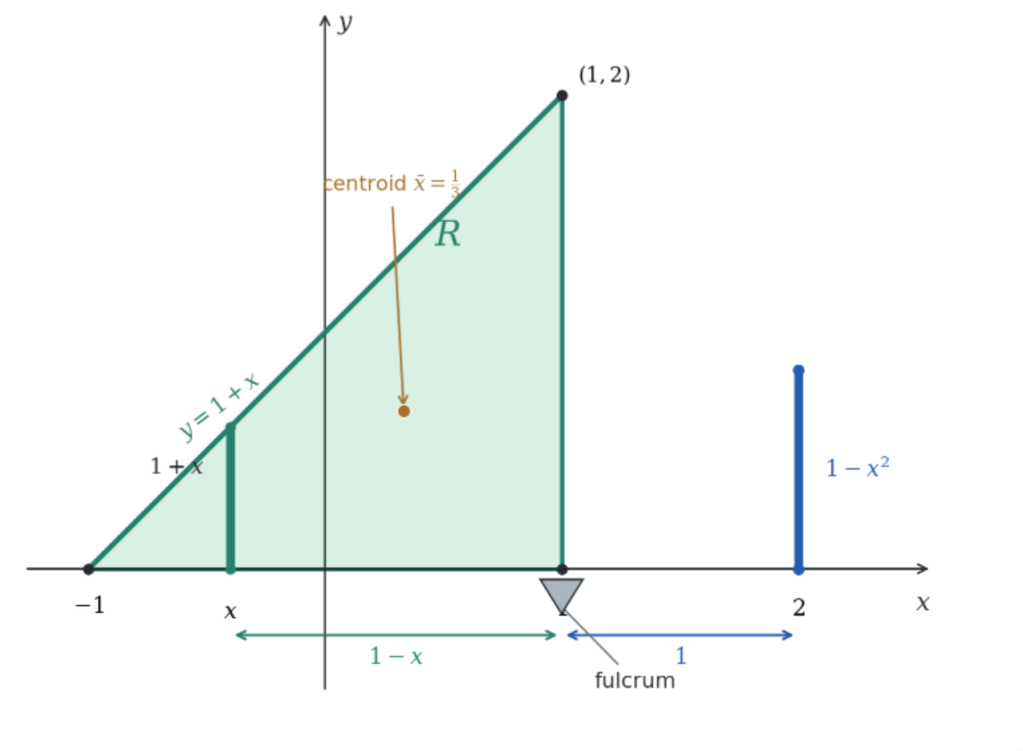
suggests how to do this. Place the fulcrum at x=1 , so that the distance of a section at x from the fulcrum is 1-x . The remaining factor 1+x is the vertical section length of a triangle R with vertices (-1,0),(1,0),(1,2) . Now leave each section of this triangle at its original position and move the corresponding section of the parabolic segment to x=2 , one unit to the right of the fulcrum. The two sections balance because

\displaystyle (1+x)(1-x)=(1-x^2)\cdot1.

For example, at x=\frac12 , the triangle has a section of length \frac32 at distance \frac12 from the fulcrum, while the parabolic segment has a section of length \frac34 placed at distance 1. Both have moment \frac34 . The same relation holds for every section. We can therefore imagine moving all the sections of the parabolic segment to the fixed point x=2 , while leaving the triangle in place. The triangle has area 2, and its center of gravity has horizontal coordinate

\displaystyle \bar{x}=\frac{-1+1+1}{3}=\frac13.

Its center of gravity is thus at distance \frac23 from the fulcrum. Balancing the two figures gives

\displaystyle S\cdot1=2\cdot\frac23=\frac43.

Since T=1 , we obtain S=\frac43T , as required. The choice of the auxiliary triangle came from the factorization of 1-x^2 . More generally, we can look for a familiar figure whose section length t(x) makes the ratio s(x)/t(x) equal to the distance from a suitable fulcrum. Here, choosing t(x)=1+x gives s(x)/t(x)=1-x . This allows us to calculate the area of the parabolic segment using only the area and center of gravity of a triangle.

Method of Exhaustion: Archimedes also gave a geometrical proof using the method of exhaustion. Start with the inscribed triangle of area T , then inscribe smaller triangles in the two remaining parabolic segments. Each new triangle has one-eighth the area of the preceding triangle, since its horizontal span is halved and the area scales as the cube of this span. Thus, the total areas added at successive stages are T,T/4,T/16,\ldots , giving the geometric series

\displaystyle S=T\left(1+\frac14+\frac1{16}+\cdots\right)=\frac43T.

To justify this infinite sum, observe that after n stages, the total uncovered area is at most 2\cdot4^{-n} , which tends to zero. This proves geometrically the same result obtained by the mechanical argument.

Paraboloids

A paraboloid of revolution gives a simpler example of the mechanical method. Let its vertex be at x=0 , its height be h , and its base radius be R . At position x , its circular section has radius \rho(x) , where \rho(x)^2=R^2x/h . Thus, its sectional area is

\displaystyle A_p(x)=\frac{\pi R^2}{h}x.

Unlike the sphere, the sectional area is already proportional to x , so we do not need to introduce another solid to cancel any terms. Compare the paraboloid with a cylinder of the same height and base radius, whose sectional area is constant, A_c=\pi R^2 . We have

\displaystyle hA_p(x)=xA_c.

This is precisely the relation needed for a balance. Place the fulcrum at x=0 and leave each cylinder section at its original position, a distance x from the fulcrum. Move the corresponding paraboloid section to a fixed distance h on the opposite side. The two sections balance. Since the cylinder has volume V_c=\pi R^2h and center of gravity at h/2 , the balance of the complete solids gives

\displaystyle V_ph=V_c\frac h2,\qquad V_p=\frac12\pi R^2h.

We can use the same idea to find the center of gravity of the paraboloid. If we leave its sections at their original positions, the moment of a section at x is proportional to xA_p(x) , which is now quadratic in x . This suggests comparing it with a cone. A cone with the same vertex, height, and base radius has sectional area A_k(x)=\pi R^2x^2/h^2 , and hence

\displaystyle xA_p(x)=hA_k(x).

Thus, each paraboloid section left in place balances the corresponding cone section moved to a fixed distance h on the opposite side. If \bar x_p is the paraboloid’s center of gravity, the balance gives V_p\bar x_p=hV_k . Using the known volumes of the paraboloid and cone, we obtain

\displaystyle \bar x_p=\frac{V_k}{V_p}h=\frac{\pi R^2h/3}{\pi R^2h/2}h=\frac23h.

The two calculations use the same principle in opposite directions. To find the volume of the paraboloid, we expressed its sections as moments of cylinder sections. To find its center of gravity, we expressed the moments of its sections as the sections of a cone.

Volume of Sphere

The sphere shows the same method more clearly in three dimensions. Place a sphere of radius r with centre at x=r , so it runs from x=0 to x=2r . Its cross-section at position x is a circle of area

\displaystyle A_s(x)=\pi\bigl(r^2-(x-r)^2\bigr)=\pi(2rx-x^2).

The problem is that this is not yet in the right form for a lever argument, because of the extra -x^2 term. So we look for a familiar solid whose sections contribute exactly \pi x^2 . A cone does this. Take a cone of height 2r and base radius 2r , with vertex at x=0 . Its cross-section at x has radius x , so \displaystyle A_k(x)=\pi x^2. Now the key step appears:

\displaystyle A_s(x)+A_k(x)=\pi(2rx-x^2)+\pi x^2=2\pi rx.

By adding the cone, the awkward quadratic term disappears, and the result becomes linear in x . That is exactly what we want, because x can now be read as a lever arm. To match this with a familiar solid, take a cylinder whose cross-sectional area is constant 4\pi r^2 . Then

\displaystyle 4\pi r^2x=2r\bigl(A_s(x)+A_k(x)\bigr).

This is the mechanical identity. The cylinder section, left at position x , balances the combined sphere-and-cone section moved to the fixed distance 2r . So the cylinder on one side balances the sphere together with the cone on the other. Since the cylinder has volume V_c=8\pi r^3 and center of gravity at distance r , the total balance gives

\displaystyle V_cr=(V_s+V_k)2r, \qquad V_s+V_k=\frac12V_c.

Now subtract the cone volume. Since V_k=V_c/3 , we get

\displaystyle V_s=\frac12V_c-\frac13V_c=\frac16V_c=\frac43\pi r^3.

The point of the argument is not just the final formula. It shows the mechanical method at work very clearly. First, write down the section of the unknown solid. Then add or compare it with sections of simple known solids until the expression becomes something like “constant times distance.” Once that happens, the law of the lever turns a problem about an unknown volume into a problem about known volumes and centers of gravity. Here the cone cancels the x^2 term, and the cylinder supplies the constant section. That is the whole strategy.

Hemisphere

A related calculation gives the center of gravity of a solid hemisphere. Take a hemisphere of radius r , with its flat base at z=0 . Its horizontal section at height z has area

\displaystyle A_h(z)=\pi(r^2-z^2)=\pi r^2-\pi z^2.

The two terms are the sectional areas of a cylinder of radius and height r , and a cone with vertex at z=0 , height r , and base radius r . Thus, the hemisphere can be measured by subtracting the cone from the cylinder, section by section. Its volume is

\displaystyle V_h=\pi r^3-\frac13\pi r^3=\frac23\pi r^3.

The same subtraction applies to their moments. The cylinder has center of gravity at r/2 , while the cone has center of gravity at 3r/4 from its vertex. Therefore, if \bar z_h denotes the center of gravity of the hemisphere,

\displaystyle V_h\bar z_h=\pi r^3\frac r2-\frac13\pi r^3\frac{3r}{4}=\frac14\pi r^4,

which gives \bar z_h=3r/8 .

Another useful extension is obtained by geometric scaling. Stretching a sphere by factors a,b,c in three perpendicular directions produces an ellipsoid and multiplies its volume by abc . Thus, once the volume of a sphere is known, the volume of an ellipsoid follows as 4\pi abc/3 . This last argument uses scaling rather than a lever, but again reduces the measurement of a new solid to that of a familiar one.

Archimedes also proved that the surface area of a sphere is equal to the curved surface area of its circumscribing cylinder. Thus, both the volume and the surface area of a sphere are two-thirds of the corresponding quantities for the complete cylinder, including its bases. The surface-area theorem, however, comes from a separate geometrical argument rather than the mechanical method of the lever.

Conclusion

Archimedes’ mechanical method shows how the area or volume of an unfamiliar figure can be found from the area, volume, and center of gravity of simpler figures. The essential step is to compare their sections so that the law of the lever applies. In the parabolic segment, the factorization 1-x^2=(1-x)(1+x) gives both the lever arm and the sections of an auxiliary triangle. For the sphere, adding a cone cancels the quadratic term in its sectional area, leaving a linear expression that can be interpreted as the moment of a cylinder. For the paraboloid, the sections are already linear, while their moments are quadratic and can therefore be compared with the sections of a cone.

These examples also explain how one might discover such constructions. The choice of auxiliary figures is guided by the algebra of their sections: triangles have linear section lengths, cylinders have constant sectional areas, cones have quadratic sectional areas, and paraboloids have linear sectional areas. Multiplication by a distance converts a section into a moment, while adding or subtracting sections allows us to simplify their expressions. In this way, finding an area or volume and finding a center of gravity become closely related problems. A suitable geometric construction allows one to be calculated from the other.

The mechanical argument does not, by itself, provide a rigorous justification for treating a figure as a collection of infinitely thin sections. Archimedes used such arguments to discover relations and then established them geometrically through exhaustion. In The Method of Mechanical Theorems, addressed to Eratosthenes, he explained this distinction between finding a mathematical result and proving it. The work, rediscovered in the Archimedes Palimpsest in 1906, gives us an unusually valuable account of mathematical discovery in antiquity.