The Nine Chapters on the Mathematical Art is one of the great foundational texts of world mathematics. If one wants to understand how premodern mathematics actually developed outside the Greek tradition, this is one of the first books to study seriously. It is practical, algorithmic, and astonishingly modern in spirit. The Chinese title is Jiǔzhāng Suànshù (九章算術). It is not a book by a single identifiable author. Rather, it is a compiled mathematical classic, assembled over time from earlier materials, probably reaching something close to its received form around the late Warring States / Qin / early Han period, with the text stabilizing roughly between the 2nd century BCE and 1st century CE. Later scholars, especially Liu Hui in the 3rd century CE, wrote major commentaries that are indispensable for understanding it. So when people talk about the Nine Chapters, they usually mean two things together: the core ancient text and the classical commentary tradition, above all Liu Hui’s. The text often gives rules and worked problems, while Liu Hui explains why the rules work.

The Nine Chapters on the Mathematical Art is one of the great classics of world mathematics: not merely a handbook of old procedures, but a record of how to organize quantity, shape, motion, exchange, and uncertainty into a coherent computational science. To read it well is to encounter a very different mathematical temperament from the one most modern readers inherit from Euclid. Greek mathematics, at least in its canonical form, often presents itself as a sequence of propositions proved from first principles. The Nine Chapters proceeds otherwise. It begins with problems arising from fields, grain, taxation, surveying, construction, and trade; it extracts from them systematic procedures; and in doing so it builds a powerful body of mathematics whose abstraction is carried not by symbols or axioms, but by algorithms. Its flavor is: start with concrete administrative, commercial, agricultural, engineering, and surveying problems, reduce them to numerical structure, give a rule, execute the algorithm, obtain the answer.
That may sound elementary, but the mathematics is often deep. The text contains early and sophisticated treatments of: fractions and proportional reasoning, extraction of square and cube roots, area and volume formulas, right-triangle methods, systems of linear equations, elimination methods very close in spirit to Gaussian elimination, interpolation-type reasoning, taxation and grain distribution calculations. In other words, this is not merely a “practical arithmetic manual.” It is a highly organized mathematical compilation. That is one reason the book feels unexpectedly modern. Beneath its concrete wording, one repeatedly finds general methods: ways of computing areas, distributing goods proportionally, extracting roots, recovering unknown quantities from errors, and solving systems of linear relations by structured elimination. The language is ancient, but the intellectual habit is startlingly recognizable. The text is always looking for a stable rule behind a changing surface. In that sense, it belongs not only to the history of Chinese mathematics, but to the larger history of mathematical thought itself.
The book consists of 246 problems arranged in nine thematic chapters. 38 in Chapter One, 46 in Chapter Two, 20 in Chapter Three, 24 in Chapter Four, 28 in Chapter Five, 28 in Chapter Six, 20 in Chapter Seven, 18 in Chapter Eight and 24 in Chapter Nine.
Different translations vary slightly in wording, but the standard chapter themes are roughly:
- Field Measurement
- Millet and Rice
- Distribution by Proportion
- Short Width
- Civil Engineering
- Fair Levies / Taxation
- Excess and Deficit
- Rectangular Arrays
- Right Triangles
Chapter 1: 方田 Fangtian (Field Measurement)
Mathematics begins with the earth, specifically the need to survey, tax, and divide land. This chapter provides formulas for rectangles, triangles, trapezoids, and circles, but its deeper significance lies in treating geometry as a “method of dissection”. Shapes are not contemplated as abstract ideals; they are cut and recombined until they are numerically tractable.
Sample Problem [1.25]: An isosceles triangle (gui tian) field has a width of 12 bu and a perpendicular length of 21 bu. Find the area.
The chapter establishes a rigorous theory of common fractions, treating them as precise ratios born from the division process.
Sample Problem [1.1]: A field is 15 bu wide and 16 bu long. Find the area. (Answer: 1 mu) .
Chapter 2: 粟米 Sumi (Millet and Rice)
This chapter moves from geometry to exchange, centering on proportionality. It details the Jin You method (the Rule of Three), providing a “standard” for proportional values between different grains and goods. It reveals that market exchange is fundamentally a mathematical comparison.
- Proportionality acts as a “universal translator” between different systems of value, allowing for the scaling and conversion of commodities.
- Sample Problem [2.1]: If 1 dou of millet is exchanged for coarse rice (where millet is 50 and rice is 30), how much rice is obtained?.
- Sample Problem [2.32]: If 160 qian is spent on 18 bricks, what is the cost per brick?.
Chapter 3: 衰分 Cuifen (Distribution by Proportion)
Here, proportionality is extended into the social domain of fairness and allocation. Mathematics serves as a “technology of justice,” dividing totals based on rank, status, or contribution. The text assumes that complex social arrangements can be handled by rule once rendered into number.
- This chapter introduces inverse proportion (fan cui), acknowledging that sometimes the highest rank should bear the least burden.
- Sample Problem [3.1]: Five hunters of different ranks get five deer. Distribute the deer according to their proportional ranks (5:4:3:2:1)..
- Sample Problem [3.20]: A loan of 1,000 qian has a monthly interest of 30. Find the interest for 750 qian returned in 9 days.
Chapter 4: 少廣 Shaoguang (Short Width)
This chapter pivots to inverse reasoning, recovering unknown dimensions from fixed areas or volumes. It moves beyond forward computation to pull unknown quantities out of specific constraints, including the extraction of square and cube roots.
- Root extraction was a massive computational achievement, utilizing iterative procedures and place-value reasoning centuries before modern calculators.
- Sample Problem [4.1]: A field has an area of 1 mu (240 bu). If the width is $1\frac{1}{2}$ bu, find the length..
- Sample Problem [4.12]: An area is 55,225 bu. Find the side of the square..
Chapter 5: 商功 Shanggong (Civil Engineering)
The text carries geometry into three dimensions to support state-level public works like canals and granaries. It provides formulas for prisms, cylinders, pyramids, and truncated solids.
- Complex volumes are understood through decomposition—dissecting solids into simpler forms like the yang ma (rectangular pyramid) to find their contents.
- Sample Problem [5.4]: A dyke has a lower width of 2 zhang, upper width of 8 chi, and height of 4 chi. Find the volume..
- Sample Problem [5.15]: Find the volume of a yang ma with width 5 chi, length 7 chi, and height 8 chi..
Chapter 6: 均輸 Junshu (Fair Transportation)
This returns to proportion but in the dynamic form of rates and interaction. It handles pursuit, shared labor, and compound rates, refusing to isolate these subjects into artificial compartments.
- Motion, flow, and tax contribution are recognized as sharing an identical numerical structure, allowing a single mathematical pattern to govern them all.
- Sample Problem [6.14]: A dog chases a rabbit. When the dog has gone 250 bu, it is 30 bu behind. How much further must it go to catch the rabbit?.
- Sample Problem [6.20]: A duck takes 7 days to fly south to north; a goose takes 9 days to fly north to south. If they start together, when do they meet?.
Chapter 7: 盈不足 Yingbuzu (Excess and Deficit)
This chapter develops the “Method of Double False Position”. By making two guesses and observing their “errors” (surplus or deficit), the correct value is inferred via linearity.
- Error is treated as information. One move toward the truth systematically by measuring how the result changes relative to the guess.
- Sample Problem [7.1]: People buy goods. If each pays 8, there is a surplus of 3; if each pays 7, there is a deficit of 4. Find the number of people and the cost.
- Sample Problem [7.14]: 5 large and 1 small container hold 3 hu; 1 large and 5 small hold 2 hu. Find what each holds..
Chapter 8: 方程 Fangcheng (Rectangular Arrays)
This chapter features the “Square Procedure” for solving simultaneous linear equations using a matrix-like array. It resembles Gaussian elimination, manipulating columns to reduce unknowns step by step.
- The externalization of relations into a manipulable grid (fangcheng) allowed the tradition to handle multiple variables as a single object of reasoning. This also led to the formalization of negative numbers (fu).
- Sample Problem [8.1]: 3 bundles of top, 2 medium, and 1 low grade cereal yield 39 dou. 2 top, 3 medium, and 1 low yield 34 dou. 1 top, 2 medium, and 3 low yield 26 dou. Find the yield of each..
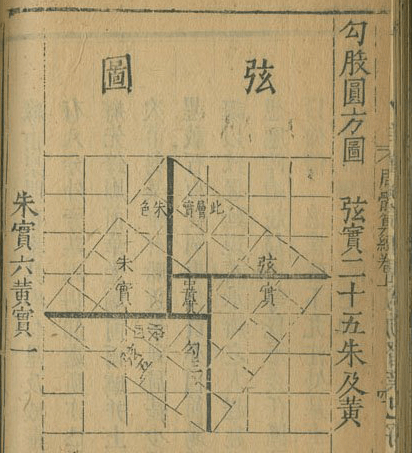
Chapter 9: 勾股 Gougu (Right-Angled Triangles)
The final chapter gathers geometry into its most classically mathematical form: the Gougu rule (the Pythagorean theorem). It applies similar triangles and indirect measurement to surveying and height visibility.
- Mathematics is a method of extracting the inaccessible from the accessible. Unseen distances (like a hill’s peak) are inferred from visible invariants.
- Sample Problem [9.1]: A gou (short side) is 3 chi and gu (long side) is 4 chi. Find the xian (hypotenuse)..
- Sample Problem [9.20]: A square city has a tree 20 bu north of the north gate. If one walks 14 bu south of the south gate and then 1,775 bu west, the tree is just visible. Find the city’s dimensions..
Taken together, the nine chapters form a remarkable whole. They do not present mathematics as a hierarchy of abstract theories, but as an interconnected repertoire of operations grounded in real situations. Yet this practical orientation should not mislead us into treating the work as merely utilitarian. The deeper one looks, the more clearly one sees abstraction at work. Area formulas encode geometric structure. Exchange problems encode proportional structure. Excess-and-deficit encodes linear structure. Rectangular arrays encode system structure. The text’s genius lies in the fact that it discovers these abstractions through computation rather than through formal symbolism.
The Algebra of Root Extraction
The extraction of square and cube roots in the fourth chapter, Shaoguang, was not a simple approximation but a rigorous, iterative algorithmic procedure. This method was likely derived from geometric dissections, such as finding the side of a square from its area, which were then “arithmetized” into systematic rod numeral manipulations. These root-extraction algorithms effectively allowed the Chinese to numerically solve equations of the form 


Matrix Notation and Gaussian Elimination
Chapter Eight, Fangcheng, contains arguably the most startling development: the use of rectangular arrays to solve systems of simultaneous linear equations. By arranging coefficients in vertical columns (right, center, and left), the Chinese externalized complex relations into a physical, manipulable grid. The text describes an elimination process known as zhi chu (direct subtraction) that is identical in spirit to Gaussian elimination, where columns were multiplied by coefficients and subtracted from one another to create a “triangular form”. The text even addresses indeterminate systems where there are more unknowns than equations, providing proportional solutions for complex social or logistical problems.
The Discovery of Negative Numbers
The necessity of the matrix elimination process in Fangcheng led directly to the first known formalization of negative numbers in history. The text provides a precise, verse-like set of rules called zheng fu for the addition and subtraction of “positive” (zheng) and “negative” (fu) numbers. To maintain clarity on the counting board, negative numbers were represented using black rods, while positive ones used red rods; alternatively, a diagonal rod was placed across the last non-zero digit to denote a negative value. Unlike many later civilizations that viewed negative results as “absurd,” the Nine Chapters integrated them as essential, valid components of an ongoing calculation.
The Method of Double False Position
Chapter Seven, Yingbuzu, introduces the Rule of False Position, a method to solve linear and even non-linear problems by measuring the “error” of initial guesses. The profound insight here is that an incorrect guess is not a failure but a carrier of structural information about the problem’s underlying linearity. By cross-multiplying two different guesses with their respective surpluses (ying) or deficits (buzu), the exact value is derived through what is effectively linear interpolation. This chapter formalized the technique of cross-multiplication, which became a staple for solving complex ratios throughout the remainder of the work.
Structural Geometry and Approximation
While often seen as purely practical, the Nine Chapters contains the seeds of limit-based reasoning and advanced structural analogy. Solid geometry was based on the “dissection” of complex bodies into standard units, such as the yang ma (rectangular pyramid) and the bie nao (pyramid with a right-angled triangular base). While initial formulas used the approximation 

This is also why the book occupies such an important place in intellectual history. It shows that there is more than one route to serious mathematics. One route proceeds through axioms, proof, and theorem. Another proceeds through problems, algorithms, and invariants hidden in numerical practice. The Nine Chapters on the Mathematical Art belongs emphatically to the second route. Its achievement is not that it anticipated modern mathematics in every detail, but that it developed its own powerful mode of mathematical thought: operational, systematic, and deeply sensitive to structure. To read it today is to be reminded that mathematics is larger than any one style of exposition. It is not identical with symbolic algebra, nor with Euclidean deduction, nor with modern formalism. It can live in counting boards, in administrative procedures, in engineering rules, in surveying diagrams, and in the disciplined handling of error.

