The ordinary Dedekind reciprocity law already has two apparently different explanations. One is geometric: a rational line cuts a lattice rectangle into two complementary regions, and the staircases along their common boundary cancel except at the endpoints. The other is analytic: the same staircase information is encoded by cotangent poles, and the residue theorem says that all nontrivial pole contributions combine into one elementary correction at the origin. These are not competing proofs. The finite Fourier transform of the sawtooth function turns the first language into the second: a lattice staircase becomes a cotangent sum, and a boundary correction becomes a Laurent coefficient.
Rademacher’s three-term relation is the cyclic version of this picture. Instead of two reciprocal boundary contributions, there are three. Each gives a Dedekind sum. In the residue proof, they arise from three separate families of poles. The elementary rational expression on the right side comes from the single point where all three cotangent factors are singular, namely the common pole at 
Let 

For the three homogeneous variables, define

This notation is symmetric in 


Here the expression on the right is the usual two-variable Dedekind sum. Rademacher’s relation is

The formula is striking because the left side is arithmetically oscillatory: each summand depends on fractional parts modulo a different denominator. The right side is a completely elementary symmetric rational expression. The residue proof explains this collapse.
The first step is to express the sawtooth function through its finite Fourier transform. Fix 


Therefore

Thus the finite Fourier transform of the sawtooth values is a cotangent. Applying finite Parseval to the functions 


This identity is the bridge between the arithmetic sum and the residue calculation. The two sawtooth factors in the Dedekind sum become two cotangent factors evaluated along a finite rational grid.
Consider the 

Take the rectangle with vertical sides 


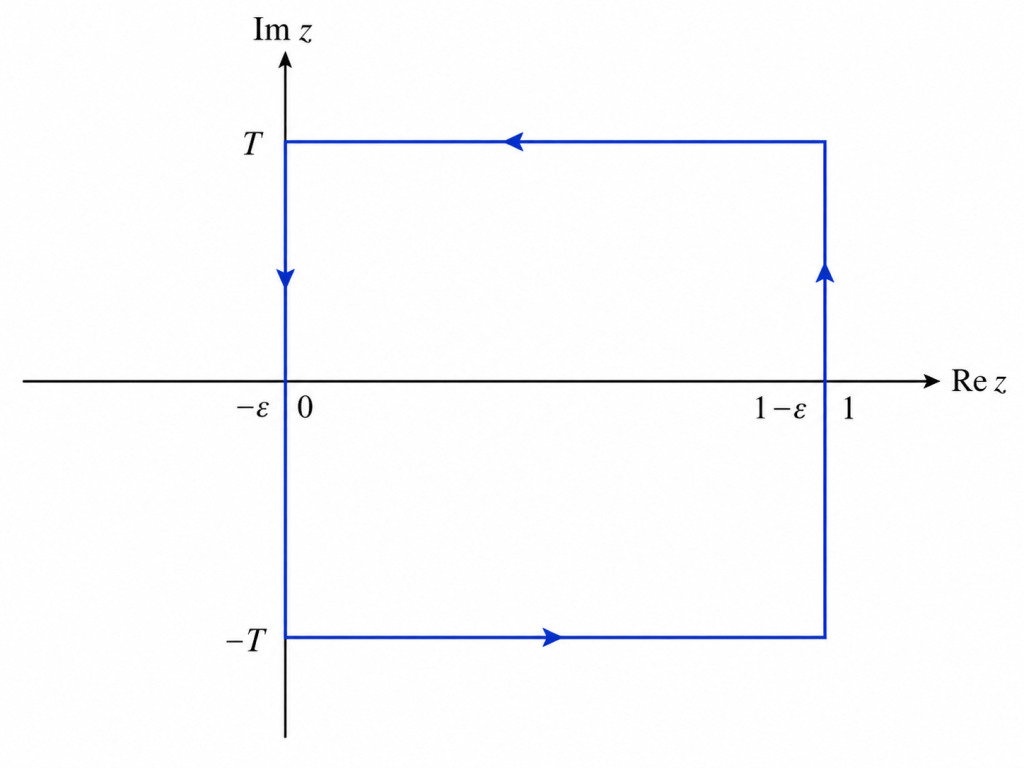
Inside this strip lie the common pole at

with 


The vertical integrals cancel because 


By the residue theorem, the sum of all residues in one period strip is therefore

This constant 


Hence

Summing over 

By cyclic symmetry,

This is the key analytic dictionary. The three Dedekind sums are not inserted artificially into the proof. They are exactly the residues coming from the three nonzero arithmetic pole families.
All three cotangent factors are singular at

To obtain the coefficient of 

Adding the three possible choices gives

This is the conceptual heart of the proof. The rational correction in the reciprocity law comes from one local computation at the common triple pole. Every term 


Add the three nonzero residue families and the residue at 

Multiplying by 
This proves Rademacher’s three-term reciprocity law.
The classical two-term Dedekind reciprocity law is already contained in the three-term formula. Set 


The cotangent proof is therefore not based on a product of only two cotangents. The correct kernel is the specialization 

The passage from two terms to three terms is now transparent. Adding a third cotangent factor creates one additional nonzero family of poles, hence one additional Dedekind sum. At the same time, the local Laurent computation at the origin gains one more cyclic contribution. The architecture of the proof does not change.
The residue proof is the Fourier-analytic form of the same cancellation seen in the Carlitz lattice-path proof. For the ordinary two-term law, consider the rational line of slope 


Every interior lattice vertex appears once with positive sign and once with negative sign. Only the two endpoint contributions remain. After one shears the variables so that one coordinate measures horizontal position and the other measures vertical error relative to the rational line, the centered mixed quadratic coefficient in the Taylor expansion becomes the Dedekind sum. The endpoint expression on the right produces the rational correction in the reciprocity law. The cotangent calculation packages exactly the same information differently. The finite Fourier transform changes the sawtooth function into a cotangent. Thus the cotangent poles are the harmonic-analytic avatars of the periodic staircase data. The nonzero pole families correspond to the nontrivial boundary arithmetic, while the Laurent expansion at
For the three-term relation, the corresponding geometry is a cyclic cone or fan decomposition. Instead of two rational regions sharing one staircase boundary, there are three rational sectors meeting at a common vertex. Each sector carries a two-dimensional lattice-boundary correction, and the associated homogeneous Dedekind sum is one of 


Thus the three cotangent pole families are the analytic shadow of three cyclic lattice-boundary corrections, and the triple pole at the origin is the analytic shadow of their common rational vertex.
The shifted Dedekind–Rademacher identities fit the same pattern. Translating a rational line moves the starting point of its staircase off the lattice. The oriented-edge cancellation still takes place, but the endpoints are now fractional translates of lattice vertices. The corresponding shifted Carlitz generating function therefore has several boundary terms rather than the single endpoint difference in the unshifted identity. After a sheared exponential substitution, its mixed quadratic coefficient becomes a shifted Dedekind–Rademacher sum. The translated boundary terms expand in periodic Bernoulli polynomials: first-order pieces produce 

Rademacher’s three-term relation should be viewed as the unshifted cyclic version of this broader principle. Whether one uses cotangent residues, Carlitz polynomials, translated cones, or periodic Bernoulli functions, the same mechanism is at work: local lattice data live on rational boundaries, interior pieces cancel under a reciprocal decomposition, and the remaining common vertex produces the explicit rational term.

