We will prove that there do not exist nonzero integers  such that

Replacing  by
by  , this is the same as saying that
  has no nonzero integer solutions. The statement is the exponent-three case of Fermat’s Last Theorem. Euler’s proof is an early and striking example of a general mathematical strategy: begin with the ordinary factorization that everyone knows, notice exactly why it is not strong enough, enlarge the setting just enough to repair that defect, and then use the repaired factorization to force an impossible infinite descent.
The proof will use complex numbers, but only in a concrete way. We will not need the language of number fields, ideals, or abstract algebra. We will construct a triangular grid in the plane, show that one can divide inside that grid much as one divides ordinary integers, and use that fact to justify a special kind of factorization. The complex numbers enter because cubes naturally bring in the third roots of unity, just as squares naturally bring in  .
.
The first elementary observation is worth keeping in mind throughout. If a product of pairwise coprime ordinary integers is a cube, then each factor is itself a cube, allowing negative cubes when the product is negative. This is simply prime factorization. Every ordinary prime occurs in the total product to an exponent divisible by  . If the factors do not share primes, then the exponent of every prime inside each individual factor must already be divisible by . Much of the proof consists of arranging situations where this simple fact can be applied.
We argue by contradiction. Suppose that some nonzero triple  satisfies
  . Among all such triples choose one for which the positive number
  is as small as possible. The entire proof will be devoted to constructing another nonzero solution whose product of absolute values is strictly smaller. Since there cannot be an endlessly decreasing sequence of positive integers, that will give the contradiction.
The chosen three integers must be pairwise coprime. Indeed, if an ordinary prime divided both  and
and  , then the equation would show that it divides
  , hence divides as well. Dividing all three integers by that prime would give a new nonzero solution with a strictly smaller product. The same argument works for any pair. Since the three integers are pairwise coprime, at most one of them is even. They cannot all be odd, because the cube of an odd integer is odd, and the sum of three odd integers is odd rather than zero. Thus exactly one of them is even. By renaming the variables, we may suppose that is even and
  are odd. Now set
This is just a change of coordinates:  and
and  . Since and are odd, both
  and
and  are integers. They are coprime, because a common divisor of and would divide both
  and
and  . They have opposite parity, because is odd. They are also nonzero. If
  , then
  , forcing
  . If
. If  , then
  , so
, so  ; but is odd, and the power of
  in the right-hand side is exactly one, while the power of in a cube must be divisible by three.
The advantage of the substitution is that the sum of cubes becomes symmetrical. Expanding  , all terms with odd powers of cancel, leaving

Thus our supposed Fermat solution gives

This is the crucial shape of the problem. The ordinary factorization of  has become a product of
  and
and  . If these two factors were always coprime, the proof would now be nearly finished. The trouble is that the prime can interfere. The expression therefore needs to be understood more deeply.
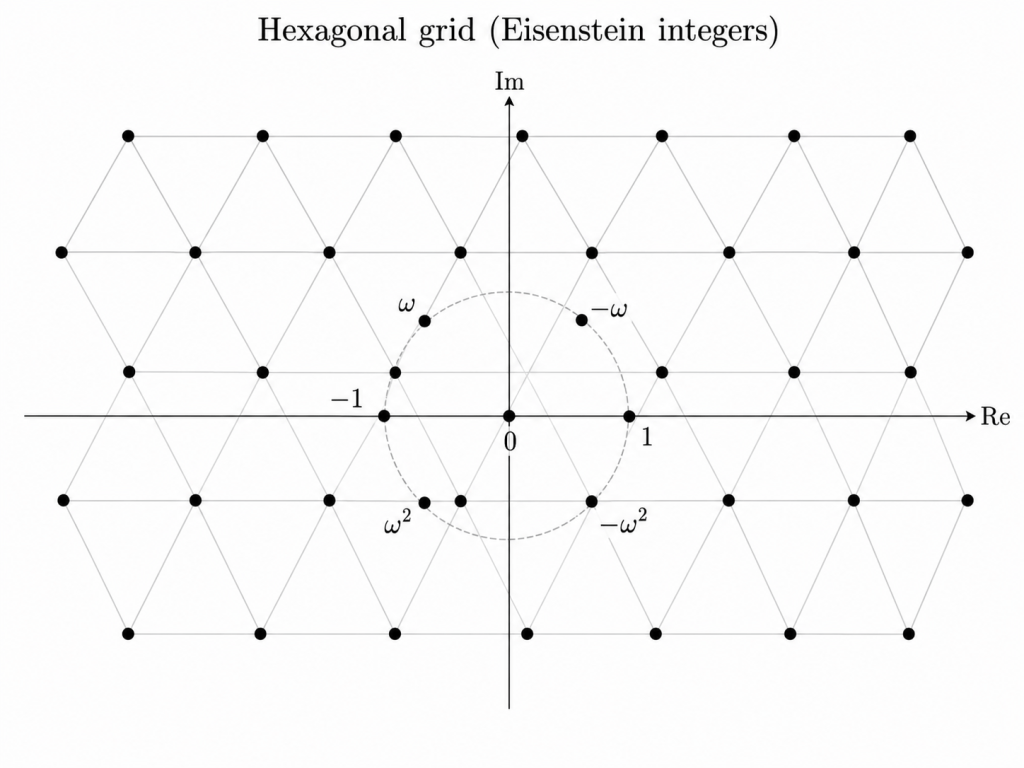
The right way to see it is to draw a triangular grid in the complex plane. Let  This number has length one and points at an angle of
  . It satisfies
  and
and  . Consider all points of the form
  , where
  and
and  are ordinary integers. These points form the vertices of a tiling of the plane by equilateral triangles of side length one. From each point one can move to its six closest neighbors by adding one of
  . The important fact is that this triangular grid is closed under multiplication. Since
  , multiplying two points in the grid gives

which is again a point of the same grid. Thus the grid has both addition and multiplication, just as the ordinary integers do. For a grid point , define its size to be its ordinary squared Euclidean distance from the origin. Since the complex conjugate of  is
is  , this size is

The key property is that sizes multiply. This is just the familiar fact that the squared length of a product of complex numbers is the product of the squared lengths. In symbols, if  and
and  are grid points, then the size of
  equals the size of times the size of .
The six points of size one are precisely . Multiplying by one of them merely rotates or reverses the triangular grid. These six elements play the role played by  among ordinary integers: they do not change divisibility in any serious way, because each has an inverse still inside the grid.
The whole reason for using this particular triangular grid is geometric. Every point in the plane lies in one of the equilateral triangles of the tiling. The furthest point of a unit equilateral triangle from its three vertices is its center, which lies at distance  from each vertex. Therefore every complex number lies within distance at most of some point of the grid.
This gives a division algorithm. Take two grid points  , with
  . The quotient
  is an ordinary complex number. Choose a nearby grid point
  whose distance from is at most , and form the remainder
  . Then
  , and the size of
  is strictly smaller than the size of , unless
  . The reason is simply that

After squaring, the size of the remainder is at most one third of the size of the divisor.
This is exactly the feature of ordinary integers that makes the Euclidean algorithm work. Repeatedly divide and take remainders; the sizes are nonnegative integers and strictly decrease, so eventually the remainder becomes zero. Hence grid points have greatest common divisors, up to multiplication by one of the six rotations. Running the Euclidean algorithm backward gives the usual Bézout relation: if two grid points have no common nontrivial divisor, then some grid-linear combination of them equals  . From this one obtains the familiar prime-divisibility rule. If an indivisible grid point divides a product but does not divide one factor, then it must divide the other. The proof is the same as for ordinary integers. If such a point
  does not divide , then and have no common nontrivial divisor, so there are grid points
  with
with  . Multiplying by , one finds that
  , and both terms on the right are divisible by . Therefore divides .
Consequently, factorization into indivisible grid factors works exactly as it does in the ordinary integers. Every nonzero grid point can be broken into indivisible factors, because if it breaks into two nontrivial pieces then each piece has smaller size. A factorization is unique because an indivisible factor on one side must divide one factor on the other side, allowing cancellation and repetition. The only ambiguity comes from the six rotations of the grid.
We now return to the expression . Write  This is a point of the triangular grid because
  . Therefore
  and
and  are both grid points. Their product is exactly

So the troublesome quadratic expression is not really a quadratic expression at all. Inside the triangular grid, it becomes the product of two ordinary-looking linear factors. The next fact is the heart of the proof. Suppose that  are coprime nonzero ordinary integers and that
  is a cube. Then there exist ordinary integers
  such that

At first this formula may look invented. In reality it is forced by the expansion of a cube. Indeed,

Thus the two formulas simply say that  itself is a cube in the triangular grid.
Before proving that, observe first that and  have opposite parity. They cannot both be even because they are coprime. If they were both odd, then would be congruent to
  modulo
  . But no cube is congruent to
  modulo : an odd cube is odd, while an even cube is divisible by . Also, cannot divide . If it did, then would not divide , and modulo
  one would have
  . But cubes modulo are only
  .
.
These two observations show that the ordinary integers  and are coprime. The quadratic expression is odd because have opposite parity; it is not divisible by because does not divide ; and any other common prime divisor would divide both and .
Now factor the cube inside the triangular grid:  The two factors on the left have no common nontrivial grid divisor. Indeed, any common divisor divides their sum , and it also divides their product . But these two ordinary integers are coprime. Therefore a common grid divisor would divide an ordinary integer combination of them equal to , so it can only be one of the six harmless rotations.
Because the product of the two relatively prime grid points is a cube, unique factorization says that each one is a cube, apart from one of the six rotations. Thus  where
where  is a grid point and
  is one of .
There is a minor parity adjustment before we can write in the desired shape  . Write
  . A point has the form exactly when its coefficient of is even, because
  . If is already even, nothing needs to be done. If is odd and
  is odd, multiply by ; its new -coefficient becomes
  , which is even. If is odd and is even, multiply by ; its new -coefficient becomes
  , again even. Since both and have cube equal to , this rotation changes neither
  nor the essential content of the equation. We may therefore assume that
  .
.
It remains to show that the leftover rotation is actually , rather than one of the four nonreal rotations. Let  so that
  and
and  . The four nonreal rotations have the form
  , where
  are each either or
  . Multiplying gives

For this to have integer coefficients,  and
and  must have the same parity. But if and had opposite parity, then the formulas for and show that they would have opposite parity. Therefore and must have the same parity.
If are both even, then and are both divisible by . If are both odd, then  , so both
  and
and  are divisible by , again making and divisible by . In either case the displayed formula would make both and even. But were coprime and of opposite parity. This contradiction shows that a nonreal rotation is impossible. The remaining rotation is , and the minus sign can be absorbed by changing to
  .
.
We have therefore proved the promised cubic description: every primitive solution of  comes from expanding a cube of the form
  .
.
We now return to the supposed smallest solution . Recall that  that
that  are coprime and of opposite parity, and that is even. Since is odd, the right side shows that is divisible by . Hence is divisible by , and is odd.
There are now two possibilities. First suppose that does not divide . Then and are coprime. The latter is odd; it is not divisible by ; and any other common prime would divide both and . Their product is a signed cube, namely  , so each factor is a signed cube. Thus there are integers
  with
with

The cubic description just proved supplies integers such that

Substituting the first formula into  gives
gives

The three factors  ,
,  , and
, and  are pairwise coprime. To see why, first note that are coprime, because any common divisor would divide both and . Since is odd, is odd and is even. Since does not divide , it does not divide . Thus and are odd and are not divisible by . Any common prime divisor of and one of
  would therefore have to divide both and . Similarly, a common divisor of and divides both their sum and their difference
  , and again must be trivial.
Since these three pairwise coprime factors multiply to a cube, each one is a signed cube. There are therefore nonzero integers  such that

Adding the three displayed cubes gives

Thus  is another nonzero solution of the original cubic equation. It is smaller, because

Since is a nonzero even integer,  . Therefore

The number is at least two, and hence is strictly smaller than its own cube. It follows that  , contradicting the choice of as the smallest nonzero solution.
It remains to consider the case in which divides . Write  . Since is divisible by ,
  is even; since are coprime,
  are coprime and does not divide . The main identity becomes

The two factors  and
and  are coprime. The second is odd because is odd and is even. It is not divisible by , because modulo it is congruent to
  , and does not divide . Finally, any prime larger than dividing both factors would divide both and , which is impossible.
Thus and are each signed cubes. Apply the cubic description to the latter. There are integers  such that

Substituting the second formula into the cube gives

Since the right side is divisible by  , its cube root is divisible by . After dividing the cube identity by , we obtain a cube of the form

The three factors  ,
,  , and
, and  are pairwise coprime. Since is odd, the formula
  forces
  to be odd and
  to be even. Hence and are odd. Any common divisor of and
  would divide both and . Any common divisor of and divides both
  and . Since are coprime, these common divisors are trivial.
Again each factor must be a signed cube. Thus there are nonzero integers such that

Their cubes add to zero: 
This is another nonzero solution of the same equation. Its product is even smaller than before, because

Thus  , and therefore . This contradicts minimality once again.
Both possibilities for lead to a strictly smaller nonzero solution. Hence the supposedly smallest solution cannot exist. Therefore there was no nonzero solution in the first place.

The proof becomes easier to remember once one sees its internal shape. Ordinary algebra transforms the original equation into a statement about the product  . The factor is the squared length of the complex point
  . The triangular grid lets us factor that squared length into two conjugate pieces, and
  , and its geometry guarantees that divisibility and factorization behave as well there as they do for ordinary integers.
The cubic parametrization is not a lucky guess. It is simply the expansion of  . Once the quadratic expression is shown to arise from an actual cube in the triangular grid, the factors , , and , or in the second case , , and , appear automatically. Their sum has exactly the form needed to manufacture a new equation of the same type. The descent is built into the algebra.
One can also now see why the prime was exceptional from the beginning. In the triangular grid one has  So, up to a rotation, the ordinary integer is already a square of a special grid point. This is why the prime interacts differently with the factor , and why Euler’s proof naturally divides into two cases. Nothing arbitrary is happening: the special treatment of is already encoded in the geometry of the triangular grid.