Certain geometric facts have an appealing simplicity that makes one hope for an equally simple picture-proof. The one-seventh triangle is a good example. Start with a triangle 


The three cevians 
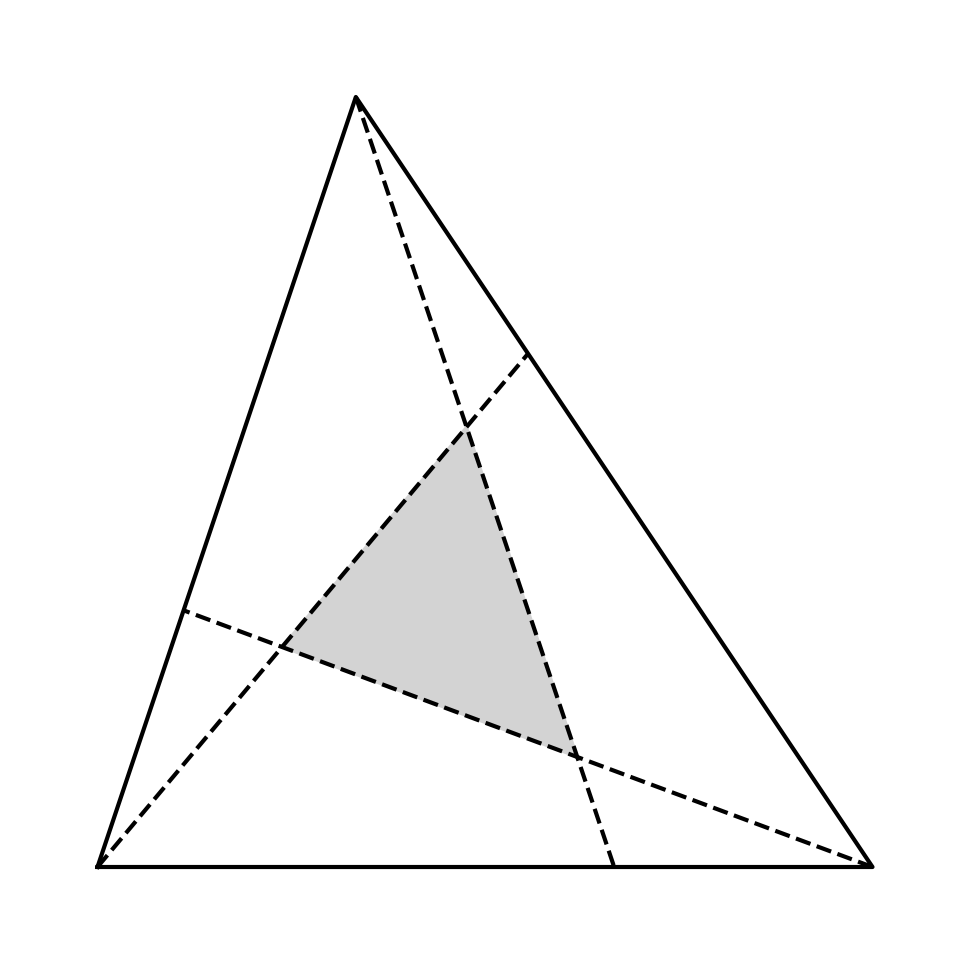
It is natural to search for a clever dissection or an auxiliary construction that makes the fraction 
The problem is affine in nature. An affine transformation preserves lines, division ratios along lines, and ratios of areas. Thus the specific angles and side lengths of
Barycentric Coordinates
Barycentric coordinates are especially well suited to this problem because they encode both affine position and side ratios directly. Use

A point 


Let points 


where 


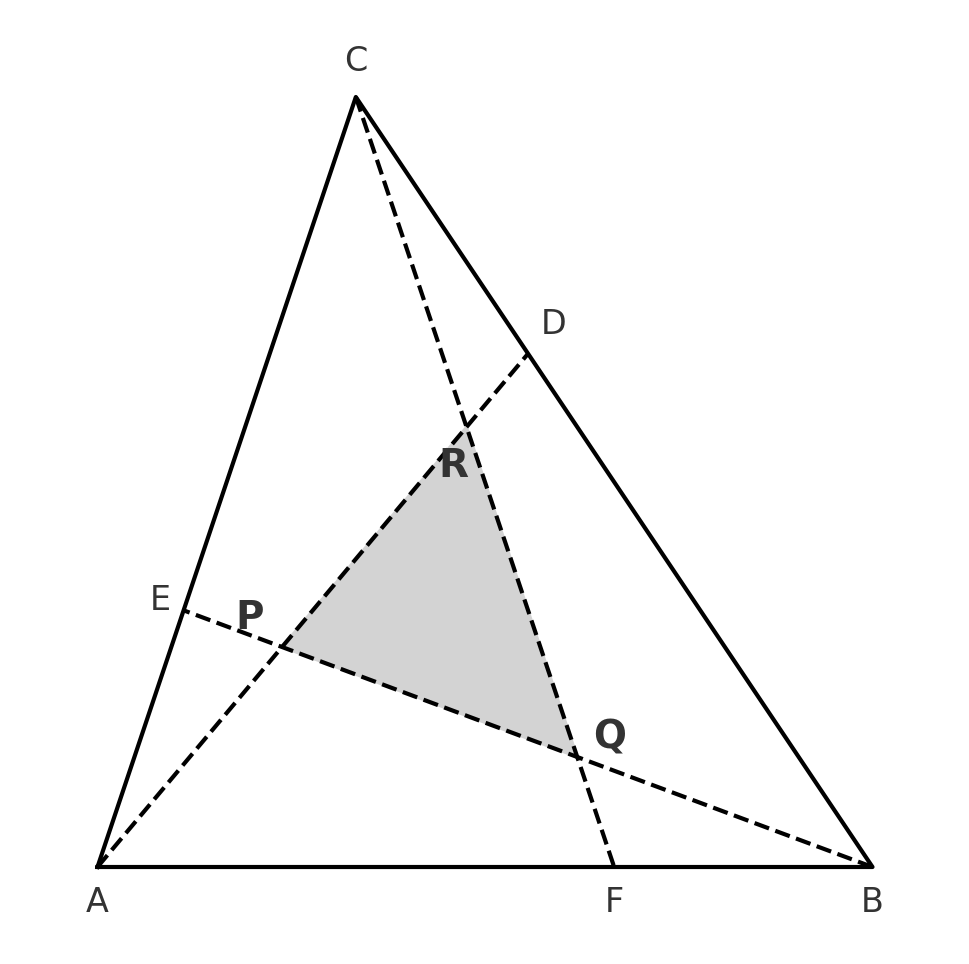
The cevians are 


Coordinates of Inner Vertices
Let us derive 


Substituting this value into the parametrization of

The same calculation, performed cyclically, gives the other two vertices:


For three normalized barycentric points, the determinant of their coordinate matrix gives the signed ratio of their triangle’s area to the area of the reference triangle:
Area Ratio Calculation
The ratio of the area of 


One way to see this is to apply an affine map sending 


Substituting the coordinates of 

where

The determinant has an unexpectedly clean factorization. Expanding along the first row, the third cofactor vanishes because its two monomials are identical. The two remaining cofactors give

Thus we have 

This is already a complete answer in the variables 
For the original configuration, 
The numerator becomes
Each factor in the denominator is 
Therefore 
Hence we have


Thus the central triangle has exactly one seventh of the area of
Routh’s Theorem
The traditional form of Routh’s theorem uses the ratios into which the points divide the sides:

These are related to the earlier variables by

and the preceding formula becomes

This is Routh’s theorem. For the one-seventh triangle, the side divisions are all 


exactly as before.
Vanishing Area: The Condition of Ceva
The central triangle has area zero precisely when the numerator vanishes:

But this is exactly Ceva’s theorem:

is the necessary and sufficient condition for the three cevians
The fact that the numerator is a square also has a geometric meaning. The quantity 

This is more than a convenient consistency check. Routh’s formula does not merely coexist with Ceva’s theorem; it contains Ceva’s concurrency criterion as the precise boundary case in which the inner triangle loses all area. The geometric event of three lines meeting at one point becomes the algebraic condition 
The Synthetic Approach
Coordinates give a direct and systematic calculation, but there is also a classical synthetic route. One proves, using parallels, similar triangles, or Menelaus’s theorem, that the three corner triangles satisfy


The three corner triangles and the central triangle fill

Putting these fractions over a common denominator gives

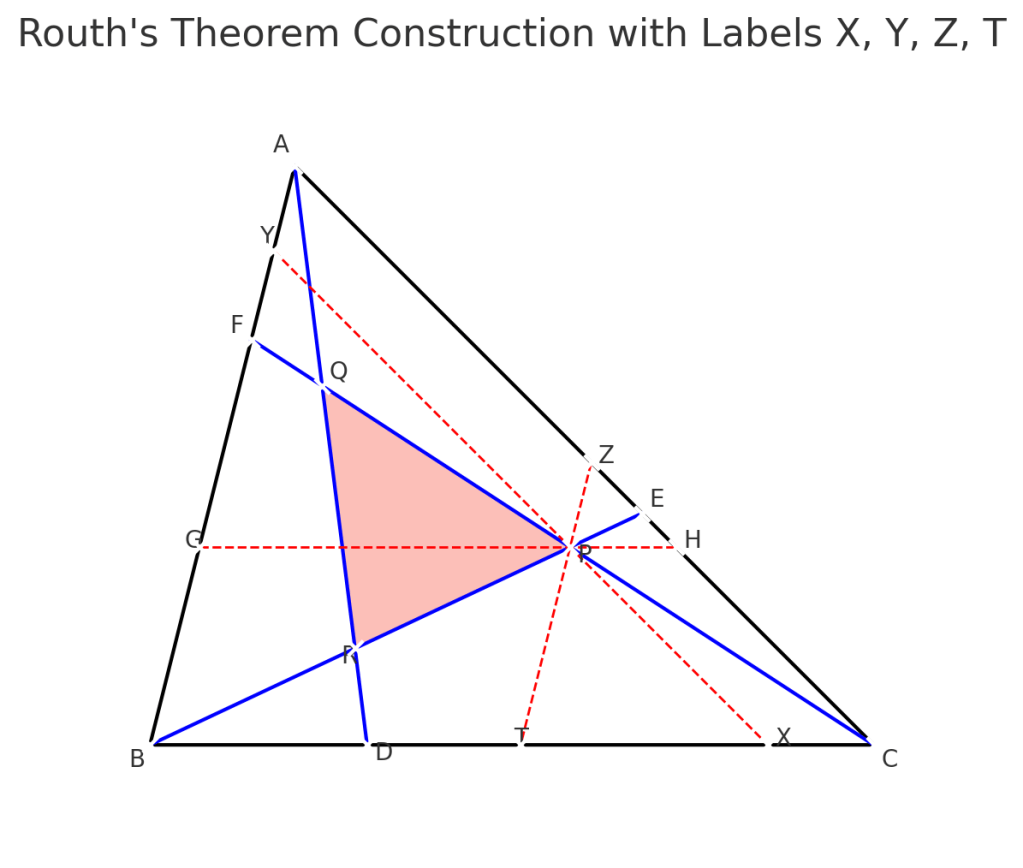
This synthetic proof is a testament to classical geometric reasoning, yet the final algebraic step underscores that the path to the explicit formula, even via synthesis, often involves significant algebraic manipulation.
What begins as a simple geometric curiosity—the appearance of the fraction 1/7—ultimately reflects a deeper mathematical structure. Through barycentric coordinates and determinants, the seemingly mysterious area ratio emerges naturally from the algebra governing cevians in a triangle. Routh’s theorem reveals that classical geometry, affine transformations, and area ratios are all connected within a single elegant framework. Even Ceva’s theorem appears as a limiting case, showing how concurrency arises when the inner triangle collapses. In the end, the 1/7 triangle is not just a puzzle, but a window into the rich interplay between geometry and algebra.

