For an odd prime  , the Legendre symbol is defined as the quadratic residue symbol,

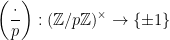
This is a character modulo and is helpful as a “harmonic” in contrast to the Gauss’s notation  and
and  which serve as indicators for being a quadratic residue and non-residue. We also distinguish
  and rest of the quadratic residues.
Some properties of Legendre symbol:
Euler’s criterion:

Periodicity:

Mutliplicativity:
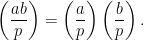
Quadratic reciprocity:
For  distinct odd primes, we have

Expressions in terms of analytic functions:

Zolotarev’s Lemma:
 is the determinant of the permutation map induced by the multiplication by
  map on
Gauss Lemma:
equals the number of residues in  that get mapped to
  .
.
Legendre symbols are quadratic (real) characters: that is they only take values  on integers coprime to . Also note that the symbol is just defined by odd . For
  , we get a trivial symbol if we define it in terms of squares/quadratic residues because every odd number is a square mod
  .
.
Quadratic residues:
What about quadratic residues modulo  for not a prime? Let’s say
  , how do we decide if a number is square mod
  .
.
The equation  has a solution modulo iff only if it has solution mod . To see that we can lift mod to , write
  where
where  . We get

This is zero mod  iff
iff  . So if
  , we can always choose such which satisfies this equation and get a solution to
  . We can continue doing this and lift the uniquely to
What about modulo  ?
?
Mod , everything is  and hence a square.
Mod  , are the only squares. So just one square in
Mod with  , there are exactly
  odd squares that is in
  , so that subgroup of squares is of index and hence cannot be defined by by a quadratic character. This is due to the fact that
  , the group is not cyclic and has two factors.
The even squares should be divisible by and should be of the form  where
where  is a square modulo
Putting all these together and the fact that  is square mod
  iff if it’s a square mod
  and for coprime integers and , we get that the subgroup of squares in
  is defined by not just one character (it’s kernel) but a list of characters one for each prime.
For odd primes powers the character is the Legendre symbol  ,
,
for  , the character is trivial,
for  , the character is a quadratic character detecting
  ,
,
for  , there are 4 quartics character defining a subgroup of index . For instance we have to detect
  for
for  .
.
To repeat the character defining the squares in cannot be defined in terms of a single character or a symbol- like we had in the case of odd primes. We have to use all the characters mentioned above to detect the subgroup. That is

We now extend the lower argument to all odd numbers.
Jacobi Symbol: For an odd positive number , we define the Jacobi symbol  mutliplicatively in as the product of Legendre symbols
 where
where

This is an extension of Legendre symbol and in fact equals the sign of the permutation of multiplication by on 
So this also non-zero values  precisely on
  , that is

and defines a character mod .

Periodicity in with period .

Multiplicativity in both arguments:
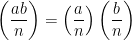
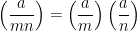
Mutiplicativity in follows from the multiplicativity of Legendre symbol and the mutiplicativity on , odd is by defintion.
Quadratic reciprocity:
For  distinct positive odd integers,



Squares and quadratic residues:

follows from the fact that Legendre symbol detects squares.
 This is because of the construction/definition we get
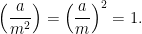
If is a square mod , then we have  .
.
If  , then has to be a non-residue. But it could happen that and still is a non-residue. For instance it can happen because
  , and then the symbol even on non residues is

Or because n is a product of primes say  and is a non-residue modulo both and
  , so .

The upper argument can be any integer, but we have restricted the lower argument to be an odd positive number. What should we do for negative or even?
We extend further.
Kronecker Symbol:
 is defined as the quadratic character mod
  given by
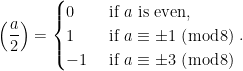
 is the sign symbol, a character on
  .
.
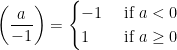

Now extend the Jacobi symbol multiplicatively with these extra definitions.
Why did we do this? Let’s say we want the Jacobi symbol  to be a character, that is in the lower argument. We already have multiplicativity over odd positive integers. Let assume that
  be a positive integer so that
we have by quadratic reciprocity for a odd positive integer

 is a character modulo . Extend the definition of to all the integers so that it equals .


This shows the motivation for the defintion of the Kronecker symbols. Note that we only considered the case used it to define the symbol for the general case, because for  , we
, we  and is not even have a periodic function in . (Also extension to from this formula doesn’t make sense!)
We again see that the values again are non-zero only for .
Now the multiplicativity in is lost! For instance consider the case  . But except for these choices we have
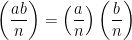
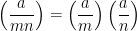
Multiplicativity in .
It is multiplicative in if we avoid the value  in the lower argument.
Periodicity in : Assume  . Because at the character is defined
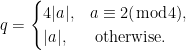
  , the period of is
  instead of sometimes-for instance when is divisible by exactly once. Note that if divides even number of times, then the symbol has to be trivial- we multiply even number of times.
So if ,  is a real character of modulus

If  ,
,  needed not be periodic, for instance take
  .
.
But might not be the conductor and there could be a much smaller period. For instance Take  ,
,  for every odd . Hence it’s a trivial character with conductor
  .
.
These list of characters  do not exhaust all the real characters.
  as we will see later is a character of modulus , but cannot be represented as for any .
Periodicity in :
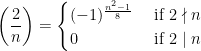
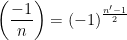
We have the following periodicity

except for the cases  and
and 
Thus if  and
and  , is a real character of modulus
But if  , need not be periodic! For example take
  .
.
Squares and residues: Just like Jacobi symbol, Kronecker doesn’t give information about whether is a square mod  .
.
Like before doesn’t imply that is a residue. But if we include , that is when is even, the values of are completely independent of whether is residue or non-residue. Like take  which is a square mod , but
  . So we don’t have
  anymore. Also doesn’t imply that has to be a non-residue. (which is a true implication for odd )
Quadratic reciprocity:
If  with
with  odd
odd
Similarly if  with
with  odd
odd

where we take the  sign iff both and are negative
Primtive quadratic characters: If  is a fundamental discriminant, that is is given by

where  is a squarefree integer, that is is the discriminant of the field
  , then

is a character of conductor  , and is primitive. That is it’s period is exactly and we can cannot induce
  from a character of smaller modulus.
In fact  decides the splitting behaviour in the field.
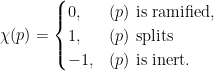
Every primitive quadratic character is of this form!
We need to be a fundamental discriminant. If it’s not the  needn’t even be a character. So sometimes it could be a character and not primitive, sometimes it’s not even a character and only when is a fundamental discriminant we have a primitive character. For
  , it’s not periodic and hence not a character, for
  it’s a primitive character and or
  we get the trivial character (so not primitive mod
  ).
).
 A Neighbourhood Of Infinity