Certain mathematical gems sparkle with an apparent simplicity, teasing us with the promise of an equally simple, “aha!” proof. The one-seventh area–triangle problem exemplifies this, inviting us to think about a direct, first-principles argument.
Recall the setup: in any triangle 


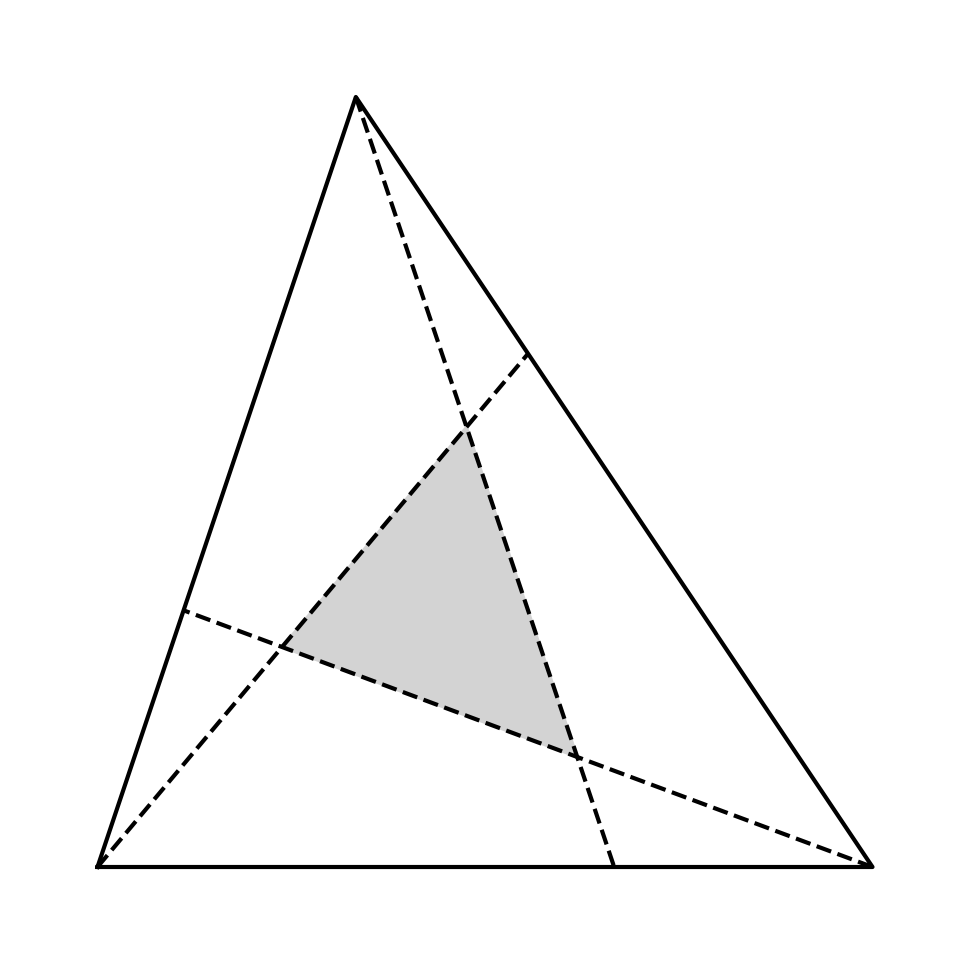
Many of us have undoubtedly pursued that elusive, purely synthetic demonstration—a clever dissection, perhaps, or an inspired choice of auxiliary lines that would render the
The Algebraic Engine: Barycentric Coordinates
When direct geometric insight for the general case stalls, a robust strategy is to “let the symbols do the talking.” Barycentric coordinates offer a natural and powerful language for problems steeped in ratios and affine properties.
Let 


The barycentric coordinates of


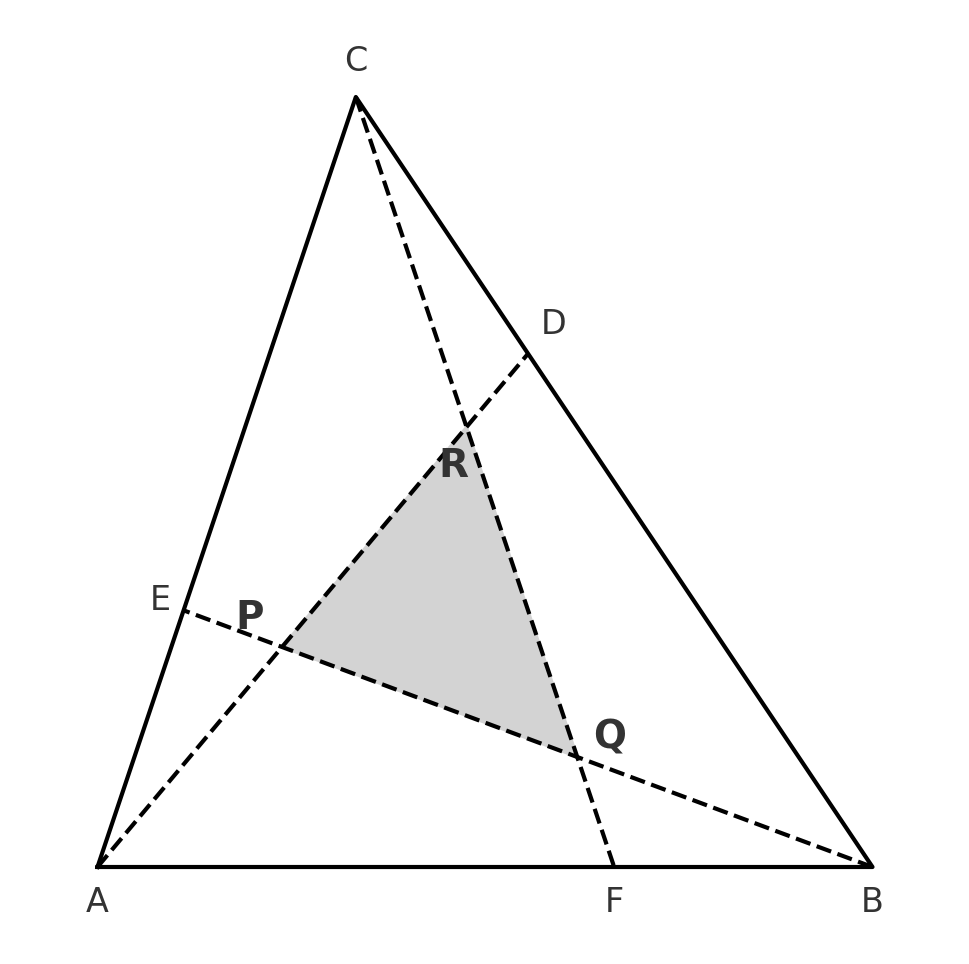
The cevians are 


Coordinates of Inner Vertices
Let’s derive the coordinates for 


From (2), 


The coordinates of 


Let 

By cyclic permutation of variables (


Let 

Let 

Area Ratio Calculation
The ratio of the area of 

Substituting the coordinates:

Let 


The third term’s parenthesis 
So, 


Substituting back 
Det’ 
The product of the denominators 

after appropriate matching of terms (the set of factors is the same due to cyclic symmetry).
Thus,

For the 

Denominator terms are each 


Routh’s Theorem
This formula is a specific instance of Routh’s Theorem. The more traditional parameterization uses ratios 


For the 
Vanishing Area: The Condition of Ceva
The inner triangle’s area vanishes if and only if the numerator 

The Synthetic Approach
While coordinates give a direct computational route, one can also prove Routh’s Theorem purely by drawing parallels and invoking similar triangles.
Let ratios be 


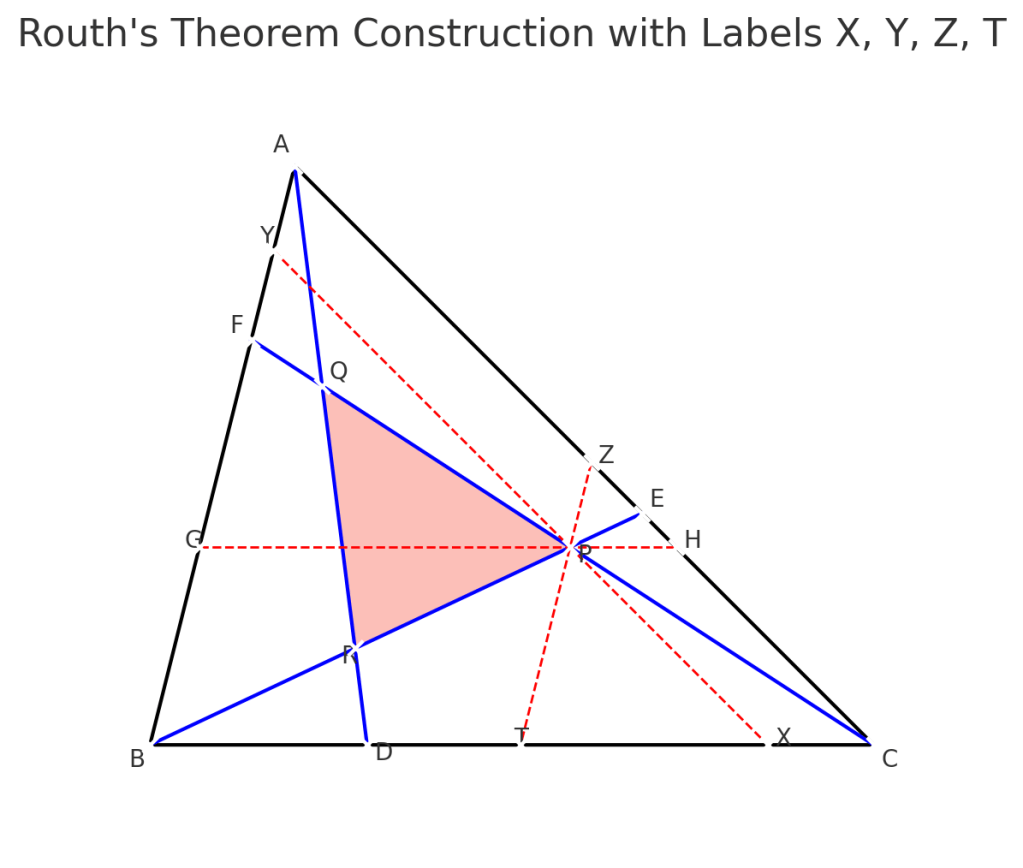
- Area of a Corner Triangle: Using similar triangles (often by constructing parallels) or Menelaus’s Theorem, they establish, for instance:
- Summation: By symmetry, the areas of
and
are found. The inner triangle’s area is then:
- Algebraic Simplification: This expression simplifies (requiring, as they note, “a bit of algebraic jugglery”) to the standard Routh’s formula:


This synthetic proof is a testament to classical geometric reasoning, yet the final algebraic step underscores that the path to the explicit formula, even via synthesis, often involves significant algebraic manipulation.
What begins as a simple geometric curiosity—the appearance of the fraction 1/7—ultimately reflects a deeper mathematical structure. Through barycentric coordinates and determinants, the seemingly mysterious area ratio emerges naturally from the algebra governing cevians in a triangle. Routh’s theorem reveals that classical geometry, affine transformations, and area ratios are all connected within a single elegant framework. Even Ceva’s theorem appears as a limiting case, showing how concurrency arises when the inner triangle collapses. In the end, the 1/7 triangle is not just a puzzle, but a window into the rich interplay between geometry and algebra.
 A Neighbourhood Of Infinity