Euclidean Algorithm: If given any two elements 


where 

For instance, for integers 

For Gaussian integers, ![\mathbb Z[i]](https://s0.wp.com/latex.php?latex=%5Cmathbb+Z%5Bi%5D+&bg=ffffff&fg=000000&s=0&c=20201002)
More generally for

the rings of integers of 


![\mathbb Z \oplus \mathbb Z[\sqrt{d}]](https://s0.wp.com/latex.php?latex=%5Cmathbb+Z+%5Coplus+%5Cmathbb+Z%5B%5Csqrt%7Bd%7D%5D+&bg=ffffff&fg=000000&s=0&c=20201002)

![\mathbb Z \oplus \mathbb Z[\frac{1+\sqrt{d}}{2}]](https://s0.wp.com/latex.php?latex=%5Cmathbb+Z+%5Coplus+%5Cmathbb+Z%5B%5Cfrac%7B1%2B%5Csqrt%7Bd%7D%7D%7B2%7D%5D+&bg=ffffff&fg=000000&s=0&c=20201002)

Another way to think of euclidean algorithm: In each of the above rings, given an arbitrary element in the field 





Euclidean rings are nice because of the gcd algorithm and we see that every ideal is a principal (generated by a single element, if there are two elements take their gcd!)
So how many quadratic rings are euclidean and how many of them are euclidean with norm as the measure of smallness? What are the Euclidean rings that are not norm-Euclidean?
Chatland, Davenpport, and independently Inkeri showed that the above list are the only rings of quadratic integers whcih are norm-Euclidean. For imaginary fields, there are not other Euclidean rings. But what about real quadratic fields, are there any 
If it’s euclidean , it’s a PID and hence have class number 1. So if we just focus on class number 1 fields, are all these fields Euclidean? In fact GRH implies that all these quadratic fields with class number 1 are Euclidean. Unconditionally Narkiewiscz showed that there at most 

We discuss the cases of 

![\mathbb Z[\sqrt 14]](https://s0.wp.com/latex.php?latex=%5Cmathbb+Z%5B%5Csqrt+14%5D+&bg=ffffff&fg=000000&s=0&c=20201002)
To show that something is not norm Euclidean, we have exhibit an element in the field 

If 



Now looking 



But it doesn’t mean that
It’s actually Euclidean!
![Z[\frac{1+\sqrt{69}}{2}]](https://s0.wp.com/latex.php?latex=Z%5B%5Cfrac%7B1%2B%5Csqrt%7B69%7D%7D%7B2%7D%5D+&bg=ffffff&fg=000000&s=0&c=20201002)
We follow the same strategy and consider

If the domain was norm-Eulcidean, we need to find 


Now checking 






Thus we see that norm cannot serve as the Euclidean function. Can we construct other functions? To understand the failure of the norm, we need to understand all the elements like 
Lemma: The only elements of the field for which there is no approximation 
![\pm \frac{26+7 \alpha}{10+3 \alpha}~~ \mod \mathbb{Z}[\alpha]](https://s0.wp.com/latex.php?latex=%5Cpm+%5Cfrac%7B26%2B7+%5Calpha%7D%7B10%2B3+%5Calpha%7D%7E%7E+%5Cmod++%5Cmathbb%7BZ%7D%5B%5Calpha%5D+&bg=ffffff&fg=000000&s=0&c=20201002)
where 
In addition, we can choose the approximation 

In fact, the norm function 


The same statement can be repharsed in terms of the integral elements as follows: The only coprime residue classes modulo any element of ![\mathbb{Z}[\alpha]](https://s0.wp.com/latex.php?latex=%5Cmathbb%7BZ%7D%5B%5Calpha%5D+&bg=ffffff&fg=000000&s=0&c=20201002)


Thus if we start with any pair of elements in the ring ![x=a/b \neq \pm \frac{26+7 \cdot \alpha}{10+3 \alpha}~~ \mod \mathbb{Z}[\alpha]](https://s0.wp.com/latex.php?latex=x%3Da%2Fb+%5Cneq++%5Cpm+%5Cfrac%7B26%2B7+%5Ccdot+%5Calpha%7D%7B10%2B3+%5Calpha%7D%7E%7E+%5Cmod++%5Cmathbb%7BZ%7D%5B%5Calpha%5D+&bg=ffffff&fg=000000&s=0&c=20201002)



On the other hand if we start with say 



We have a slightly stronger lemma:
The only coprime residue classes modulo any element of 
That is we can even assume that the remainder 


Proof sketch of the lemma: Explicitly construct some regions with good approximations, and then use the action by units to cover rest of the region. (“Method of Automorphs”). Then only two points (residues mentioned above) inside the fundamental domain of the integer lattice remain uncovered.
![\mathbb Z[\alpha]~](https://s0.wp.com/latex.php?latex=%5Cmathbb+Z%5B%5Calpha%5D%7E+&bg=ffffff&fg=000000&s=0&c=20201002)
From the above discussion we see that there is a problem with the prime

defined on primes 
With this function we given 


If 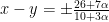

Motzkin’s lemma: Definition 2.15. Let


Then

For a Euclidean domain, these sets are given by elements of size atmost 



But the lemma says, these conditions are enough to construct the euclidean function! In fact
define 


We start with units and define 

Variant of Motzkin’s lemma: Consider a set of distinct non associate primes 



If every prime of the domain is contained in some 
Thus if we start with some admissible set of primes, and verify that all primes are in some 




Theorem 1:

for some well-factorable functions 


Theorem 2: Suppose 


Theorem 3: Suppose 





References:
Clark, D.A. A quadratic field which is Euclidean but not norm-Euclidean. Manuscripta Math 83, 327–330 (1994). https://doi.org/10.1007/BF02567617
D. A. Clark and M. R. Murty, The Euclidean algorithm for Galois extensions of Q, J. Reine Angew. Math.459(1995), 151–162
M. Harper, ![\mathbb Z[\sqrt{14}]](https://s0.wp.com/latex.php?latex=%5Cmathbb+Z%5B%5Csqrt%7B14%7D%5D&bg=ffffff&fg=444444&s=0&c=20201002)
H. Chatland and H. Davenport,Euclid’s algorithm in real quadratic fields, Canad. J. Math. Vol.2(1950), 289–296
W. Narkiewicz, Euclidean algorithm in small Abelian fields, Funct. Approx. Comment. Math.37(2007), 337–340
P. J. Weinberger, On Euclidean rings of algebraic integers, Analytic number theory (Proc. Sympos. Pure Math., Vol.XXIV, St. Louis Univ.,St. Louis, Mo., 1972), Amer. Math. Soc., Providence, R. I., 1973, pp.321–332.
Franz Lemmermeyer, The Euclidean Algorithm in Algebraic Number Fields
 A Neighbourhood Of Infinity