What are Hecke Operators? These are some operators acting on automorphic forms on some arithmetic groups. Not all discrete subgroups have these operators and existence of these operators is a reason for why the spectrum of these group is different from a generic spectrum and has different statistics compared to the universal distributions expected. It’s crucial to use the fact that these operators commute with the Laplacian to understand the spectrum of Laplacian better.
One of the first application of these operators are to prove multiplicativity of Fourier coefficients of certain  series like the Ramanujan
  function, which is a immediate consequence of the multiplicative properties of the Hecke operators.
We first treat the case of  . Also we don’t bother a lot about weights, characters etc. (Everything can be generalized using appropriate averages over slash operators)
We present some different ways to look at the Hecke operators.
As operators on functions of lattices:
To every lattice  , we define the operator
  on function of lattices as an averaging operator over the sublattices of index
  .
.
![\displaystyle T_n (F) (\Lambda) = \sum_{\substack{\Lambda' \subseteq \Lambda \\ [\Lambda: \Lambda'] =n}} F(\Lambda').](https://s0.wp.com/latex.php?latex=%5Cdisplaystyle+T_n+%28F%29+%28%5CLambda%29+%3D+%5Csum_%7B%5Csubstack%7B%5CLambda%27+%5Csubseteq+%5CLambda+%5C%5C+%5B%5CLambda%3A+%5CLambda%27%5D+%3Dn%7D%7D+F%28%5CLambda%27%29.&bg=ffffff&fg=000000&s=0&c=20201002)
This index condition can also be stated in term of determinants as follows

where the sum is over the cosets  of matrices of determinant equal to .
If the  is a weight
  form, we define
![\displaystyle T_n (f) (\Lambda) = n^{k-1}\sum_{\substack{\Lambda' \subseteq \Lambda \\ [\Lambda: \Lambda'] =n}} f(\Lambda').](https://s0.wp.com/latex.php?latex=%5Cdisplaystyle+T_n+%28f%29+%28%5CLambda%29+%3D+n%5E%7Bk-1%7D%5Csum_%7B%5Csubstack%7B%5CLambda%27+%5Csubseteq+%5CLambda+%5C%5C+%5B%5CLambda%3A+%5CLambda%27%5D+%3Dn%7D%7D+f%28%5CLambda%27%29.&bg=ffffff&fg=000000&s=0&c=20201002)
Also the  can viewed as the sum over lattices that contain as an index
  subgroup.
That is
![\displaystyle T_p (f) (\Lambda) =p^{k-1} \sum_{\substack{\Lambda' \subseteq \Lambda \\ [\Lambda: \Lambda'] =n}} f(\Lambda')= \frac{1}{p} \sum_{\substack{\Lambda \subseteq \Lambda'' \\ [\Lambda'': \Lambda] =p}} f(\Lambda'')](https://s0.wp.com/latex.php?latex=%5Cdisplaystyle+T_p+%28f%29+%28%5CLambda%29+%3Dp%5E%7Bk-1%7D+%5Csum_%7B%5Csubstack%7B%5CLambda%27+%5Csubseteq+%5CLambda+%5C%5C+%5B%5CLambda%3A+%5CLambda%27%5D+%3Dn%7D%7D+f%28%5CLambda%27%29%3D+%5Cfrac%7B1%7D%7Bp%7D+%5Csum_%7B%5Csubstack%7B%5CLambda+%5Csubseteq+%5CLambda%27%27+%5C%5C+%5B%5CLambda%27%27%3A+%5CLambda%5D+%3Dp%7D%7D+f%28%5CLambda%27%27%29+&bg=ffffff&fg=000000&s=0&c=20201002)
The sublattices or the representatives of are explicitly given by

So we have the following explicit formulae for the action on the functions. Let  denote the lattice:


As double coset operators:
If  is a automorphic function satisfying
  (or say
  ), then
 for
for  not in
  need not be automorphic. So we try to find restore the modularity by some averaging.
If  is a finite union of the left-cosets
  , then we can average over these
  to produce a automorphic function. Consider the average

where

Now when we act by ,  is mapped to one of the ‘s mod the on the left. Hence the average over is automorphic.
Note that for this to work we need the finiteness of the left cosets for the double coset  . This finiteness is a very non-generic property, and that’s the reason most groups don’t have Hecke Operators.
More generally, we can also take  and write it as left cosets of
  and average to map a invariant function to
  invariant function.
The Hecke operator previously defined turns out to be the Double coset operator
![\displaystyle \Gamma \left[\begin{array}{ll} 1 & 0 \\ 0 & p \end{array}\right] \Gamma](https://s0.wp.com/latex.php?latex=%5Cdisplaystyle+%5CGamma+%5Cleft%5B%5Cbegin%7Barray%7D%7Bll%7D+1+%26+0+%5C%5C+0+%26+p+%5Cend%7Barray%7D%5Cright%5D+%5CGamma&bg=ffffff&fg=000000&s=0&c=20201002)
For  , we get
![\displaystyle \Gamma \left[\begin{array}{ll} 1 & 0 \\ 0 & p \end{array}\right] \Gamma=M_p =\left \{ \gamma \in M_{2}(\mathbb{Z}): \quad \det \gamma=p \right\}](https://s0.wp.com/latex.php?latex=%5Cdisplaystyle+%5CGamma+%5Cleft%5B%5Cbegin%7Barray%7D%7Bll%7D+1+%26+0+%5C%5C+0+%26+p+%5Cend%7Barray%7D%5Cright%5D+%5CGamma%3DM_p+%3D%5Cleft+%5C%7B+%5Cgamma+%5Cin+M_%7B2%7D%28%5Cmathbb%7BZ%7D%29%3A+%5Cquad+%5Cdet+%5Cgamma%3Dp+%5Cright%5C%7D&bg=ffffff&fg=000000&s=0&c=20201002)
Hence it’s the same operators.
But the good thing about this perspective is that, now we can define Hecke operators for any group.
If
![\displaystyle \Gamma =\Gamma_1(N) =\left\{\left[\begin{array}{ll} a & b \\ c & d \end{array}\right] \in S L_{2}(\mathbb{Z}):\left[\begin{array}{ll} a & b \\ c & d \end{array}\right] \equiv\left[\begin{array}{ll} 1 & * \\ 0 & 1 \end{array}\right] \quad \bmod N\right\},](https://s0.wp.com/latex.php?latex=%5Cdisplaystyle+%5CGamma+%3D%5CGamma_1%28N%29+%3D%5Cleft%5C%7B%5Cleft%5B%5Cbegin%7Barray%7D%7Bll%7D+a+%26+b+%5C%5C+c+%26+d+%5Cend%7Barray%7D%5Cright%5D+%5Cin+S+L_%7B2%7D%28%5Cmathbb%7BZ%7D%29%3A%5Cleft%5B%5Cbegin%7Barray%7D%7Bll%7D+a+%26+b+%5C%5C+c+%26+d+%5Cend%7Barray%7D%5Cright%5D+%5Cequiv%5Cleft%5B%5Cbegin%7Barray%7D%7Bll%7D+1+%26+%2A+%5C%5C+0+%26+1+%5Cend%7Barray%7D%5Cright%5D+%5Cquad+%5Cbmod+N%5Cright%5C%7D%2C&bg=ffffff&fg=000000&s=0&c=20201002)
then we have
![\displaystyle \Gamma \left[\begin{array}{ll} 1 & 0 \\ 0 & p \end{array}\right] \Gamma=M_p =\left \{ \gamma \in M_{2}(\mathbb{Z}): \gamma \equiv\left[\begin{array}{ll} 1 & * \\ 0 & p \end{array}\right] \quad \bmod N, \det \gamma=p \right\}](https://s0.wp.com/latex.php?latex=%5Cdisplaystyle+%5CGamma+%5Cleft%5B%5Cbegin%7Barray%7D%7Bll%7D+1+%26+0+%5C%5C+0+%26+p+%5Cend%7Barray%7D%5Cright%5D+%5CGamma%3DM_p+%3D%5Cleft+%5C%7B+%5Cgamma+%5Cin+M_%7B2%7D%28%5Cmathbb%7BZ%7D%29%3A+%5Cgamma+%5Cequiv%5Cleft%5B%5Cbegin%7Barray%7D%7Bll%7D+1+%26+%2A+%5C%5C+0+%26+p+%5Cend%7Barray%7D%5Cright%5D+%5Cquad+%5Cbmod+N%2C+%5Cdet+%5Cgamma%3Dp+%5Cright%5C%7D&bg=ffffff&fg=000000&s=0&c=20201002)
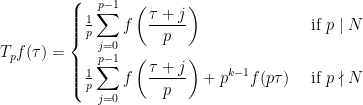
Thus we get the following expressions for Hecke operators on congruence subgroups.
Another view point: (Commensurate subgroups)
The decomposition of into left cosets of is equivalent to finding the representatives of  where
where  is the intersection of and it’s conjugate. In fact, if we have

then we have

Thus the finiteness of left cosets  is equivalent to the finiteness of
  , that is the intersection
  of and it’s conjugate
  is of finite index in . So and have to be “commensurate”.
So to find Hecke operators we need  ‘s such that and are commensurate. Not all have such elements . Having these is a very special property and is not always true. The arithmetic groups like
  or
or  are very non-generic, that why we found Hecke operators. In the case of all the elements
  form the “commensurate” subgroup (check that ‘s with
  for a group)
As correspondences:
The double coset operator formally helps us to map  to
to  That is we have a map from divisor on
  to the divisor on
Or we can just think of it as multivalued function

In the lattice picture for , we are mapping one lattice to all the lattices of index .
This multivalued function is captured by it’s graph in  . The projection from the graph to the first factor is unique for a single valued function, but now has a degree because of the multi-valuedness. (all those that map to the same point).
For instance in case of  the correspondence is basically the map
The first map  is basically the reduction
  and the second map
  is
is  obtain by reduction after conjugating , that is it’s obtained by reduction using the isomorphism

In terms of Fourier expansion:
If we have the fourier expansion
 ,
,
the expansion of  is given by

In particular for  , we have

This is what allows us to get multiplicative relations for eigenfunctions from the multiplicative relations on the operators.
The algebra structure:
We have the following relations for Hecke operators on  .
.

The first relation is basically the fact that for a sublattice  of index
  of a lattice , there is a unique lattice
  such that
 ![\displaystyle [\Lambda: \Lambda''] =n, [\Lambda'': \Lambda']=m.](https://s0.wp.com/latex.php?latex=%5Cdisplaystyle+%5B%5CLambda%3A+%5CLambda%27%27%5D+%3Dn%2C+%5B%5CLambda%27%27%3A+%5CLambda%27%5D%3Dm.&bg=ffffff&fg=000000&s=0&c=20201002)
The other relation for prime powers also follows by looking at whether  is contained in between the lattices and or not.
In terms of the double cosets
If we have two double cosets
 ,
,
the product ![{[\Gamma g \Gamma][\Gamma h \Gamma ]}](https://s0.wp.com/latex.php?latex=%7B%5B%5CGamma+g+%5CGamma%5D%5B%5CGamma+h+%5CGamma+%5D%7D&bg=ffffff&fg=000000&s=0&c=20201002) acts on by
acts on by
![\displaystyle [\Gamma g \Gamma][\Gamma h \Gamma ] (f) (z) = \sum_{g_i, h_j} f(g_ih_j z)](https://s0.wp.com/latex.php?latex=%5Cdisplaystyle+%5B%5CGamma+g+%5CGamma%5D%5B%5CGamma+h+%5CGamma+%5D+%28f%29+%28z%29+%3D+%5Csum_%7Bg_i%2C+h_j%7D+f%28g_ih_j+z%29&bg=ffffff&fg=000000&s=0&c=20201002)
More Examples:
We will now consider the case of  . Even here the double cosets with
  give commensurability (finiteness ) and hence give Hecke operators on the automorphic forms.
The distinct double cosets can be parametrized by diagonal matrices

In the case of , 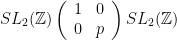 corresponds to the Hecke operator . We also get the same operator for

If we restrict all the  to be powers of , we generate the “local” Hecke algebra. But the algebra can be generated by elements of the form

That is all the double cosets operators  with
with  ,
,  , and powers of , can be written as rational function functions of the operators corresponding to the elements
  , and these generators are algebraically independent.
For the case of symplectic group  , the algebra is generated by operators
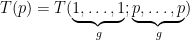
and


 A Neighbourhood Of Infinity