Look at the beautiful book The Theory of Irrationalities of Third Degree by Delone and Faddeev.
The correspondence is between cubic rings and integral binary cubic forms up to equivalences. This correspondence is crucial to understand statistics of cubic rings (and fields). For instance, how do we count them by discriminants, how are the lattices distributed in the space of lattices, how do we count them by Galois groups etc etc.
Cubic Rings are commutative rings which are of rank 3 as free modules over 

![\displaystyle \mathbb Z[\alpha] ,](https://s0.wp.com/latex.php?latex=%5Cdisplaystyle+%5Cmathbb+Z%5B%5Calpha%5D+%2C&bg=ffffff&fg=000000&s=0&c=20201002)


We consider cubic rings up to isomorphism (as rings). That is the presentation/generators of the rings might look different, but you can find a map that preserve the ring structures.
Binary cubic forms are expressions of the form

There is a “twisted” action of 

We now state the correspondence.
Delone-Fadeev, Gan-Gross-Savin:

The correspondence preserves the discriminants.
Discriminant of the cubic ring: Discriminant of the cubic ring 

That is if 


Note that given the multiplication map
Trace of an element 


Discriminant of the binary cubic form: For a cubic form 


The correspondence can be stated in several equivalent forms. Thinking in these different ways helps us to understand various aspects. Some formulations are betters to understand the independence on the choice of basis, some formulations give explicit way to write down the cubic form given the cubic ring, some help us to see the action of the groups (under changes of basis) clearly etc.
Method 1 (Wedge product): The equivalence can be given by the following map

This is a cubic map and if we write 


Method 2 (quadratic resolvent): There is a unique quadratic ring 
Quadratic rings up to isomorphism are determined by their discriminants!
![\displaystyle \begin{aligned} {\text { Quadratic Rings }} / \text { isom } & \stackrel{1: 1}{\longleftrightarrow} {\text{Discriminants }}{D \in \mathbb{Z}: D \equiv 0,1(\bmod 4)} \\ R & \mapsto \text{Disc}(R) \\ \mathbb{Z}[\tau] /\left(\tau^{2}-D \tau+\frac{D^{2}-D}{4}\right) & \leftarrow D \end{aligned} .](https://s0.wp.com/latex.php?latex=%5Cdisplaystyle+%5Cbegin%7Baligned%7D+%7B%5Ctext+%7B+Quadratic+Rings+%7D%7D+%2F+%5Ctext+%7B+isom+%7D+%26+%5Cstackrel%7B1%3A+1%7D%7B%5Clongleftrightarrow%7D+%7B%5Ctext%7BDiscriminants+%7D%7D%7BD+%5Cin+%5Cmathbb%7BZ%7D%3A+D+%5Cequiv+0%2C1%28%5Cbmod+4%29%7D+%5C%5C+R+%26+%5Cmapsto+%5Ctext%7BDisc%7D%28R%29+%5C%5C+%5Cmathbb%7BZ%7D%5B%5Ctau%5D+%2F%5Cleft%28%5Ctau%5E%7B2%7D-D+%5Ctau%2B%5Cfrac%7BD%5E%7B2%7D-D%7D%7B4%7D%5Cright%29+%26+%5Cleftarrow+D+%5Cend%7Baligned%7D+.&bg=ffffff&fg=000000&s=0&c=20201002)
Now consider the map 

This map reduces to a map on 




Method 3 (Index of subring): For an element 
![\mathbb Z[\alpha] .](https://s0.wp.com/latex.php?latex=%5Cmathbb+Z%5B%5Calpha%5D+.&bg=ffffff&fg=000000&s=0&c=20201002)

![\displaystyle [R:\mathbb Z[\alpha]] .](https://s0.wp.com/latex.php?latex=%5Cdisplaystyle+%5BR%3A%5Cmathbb+Z%5B%5Calpha%5D%5D+.&bg=ffffff&fg=000000&s=0&c=20201002)


![\displaystyle [R:\mathbb Z[\alpha] = f(X,Y)](https://s0.wp.com/latex.php?latex=%5Cdisplaystyle+%5BR%3A%5Cmathbb+Z%5B%5Calpha%5D+%3D+f%28X%2CY%29&bg=ffffff&fg=444444&s=0&c=20201002)

Method 4 (Discriminants): Using the fact that the discriminant is the square of covolume, we can see that
![\displaystyle f(X,Y) =[R:\mathbb Z[\alpha] =\sqrt\frac{\text{disc}(\alpha)}{\text{disc}(R)} .](https://s0.wp.com/latex.php?latex=%5Cdisplaystyle+f%28X%2CY%29+%3D%5BR%3A%5Cmathbb+Z%5B%5Calpha%5D+%3D%5Csqrt%5Cfrac%7B%5Ctext%7Bdisc%7D%28%5Calpha%29%7D%7B%5Ctext%7Bdisc%7D%28R%29%7D+.&bg=ffffff&fg=000000&s=0&c=20201002)
Method 5 (Geometry): A cubic form 


If we have the cubic ring, we can determine the cubic forms also by geometry (we need to find an equation defining the variety inside 

Method 6 (Explicit in terms of a basis): Assume that the cubic ring is generated by 


So we have
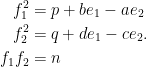
Computing 

Thus we have 


Example: If we take ![\displaystyle R=\mathbb Z[\sqrt[3]{2}].](https://s0.wp.com/latex.php?latex=%5Cdisplaystyle+R%3D%5Cmathbb+Z%5B%5Csqrt%5B3%5D%7B2%7D%5D.+&bg=ffffff&fg=000000&s=0&c=20201002)
![1, \sqrt[3]{2}, \sqrt[3]{4} .](https://s0.wp.com/latex.php?latex=1%2C+%5Csqrt%5B3%5D%7B2%7D%2C+%5Csqrt%5B3%5D%7B4%7D+.&bg=ffffff&fg=000000&s=0&c=20201002)


On the otherhand the zero form 
![\displaystyle \mathbb Z[X,Y]/ (XY, X^2, Y^2) .](https://s0.wp.com/latex.php?latex=%5Cdisplaystyle+%5Cmathbb+Z%5BX%2CY%5D%2F+%28XY%2C+X%5E2%2C+Y%5E2%29+.&bg=ffffff&fg=000000&s=0&c=20201002)
Remarks: If ![\mathbb Q [X]/(f(X,1))](https://s0.wp.com/latex.php?latex=%5Cmathbb+Q+%5BX%5D%2F%28f%28X%2C1%29%29&bg=ffffff&fg=444444&s=0&c=20201002)


This concludes the description of the correspondence– now how do we use the correspondence to count things? The corresponding helped us to see cubic rings in terms of orbits of 
Bhargava’s work: If we want to generalize to quartic, quintic one can carryout the resolvent method as above. That is, we need to find a map to cubic, sextic ring respectively that preserves the discriminants. But there could be multiple such maps to different cubic (sextic) rings! Look at Bhargava’s series of papers on Higher Composition Laws to see see how to find different resolvent maps, and parameterize the pairs 


Reducing 


Quartic case: The fundamental resolvent map is


The quintic is more complicated. But the geometric picture is the same, we are trying to define the 
Quintic case: The fundamental resolvent map is


and we have the correspondence

 A Neighbourhood Of Infinity