Given non-zero elements  and
and  in a field
  , the quaternion algebra
  over a field is the 4-dimensional vector space with the relations

In characteristic  , the quaternion algebra
  is defined by the relations

Any algebra generated by non-zero elements  ,
,  satisfying these relations with and non-zero has to be the quaternion algebra, that is it will be 4-dimensional and generated by , and
  .
.
If or are zero, we wont get a quaternion algebra. For instance ![{\mathbb F[i, j]}](https://s0.wp.com/latex.php?latex=%7B%5Cmathbb+F%5Bi%2C+j%5D%7D&bg=ffffff&fg=000000&s=0&c=20201002) modulo the relations
modulo the relations  is just 3-dimensional.
We denote by  , then we have
  when
when  .
.
We assume from now, in characteristic 2 we have to make some modifications to all the statements and arguments. (Basically because quadratic forms over characteristic behave differently)
Examples: a) Hamiton’s quaternions are  . They are closely related to the rotations
  ,
,  and the group
  .
.
b) The algebra  is isomorphic to the algebra of matrices
  by the following identification
![\displaystyle 1 \mapsto\left[\begin{array}{cc} 1 & 0 \\ 0 & 1 \end{array}\right],~~i \mapsto\left[\begin{array}{cc} 1 & 0 \\ 0 & -1 \end{array}\right], ~~j \mapsto\left[\begin{array}{ll} 0 & 1 \\ 1 & 0 \end{array}\right], ~~k \mapsto\left[\begin{array}{cc} 0 & 1 \\ -1 & 0 \end{array}\right]](https://s0.wp.com/latex.php?latex=%5Cdisplaystyle+1+%5Cmapsto%5Cleft%5B%5Cbegin%7Barray%7D%7Bcc%7D+1+%26+0+%5C%5C+0+%26+1+%5Cend%7Barray%7D%5Cright%5D%2C%7E%7Ei+%5Cmapsto%5Cleft%5B%5Cbegin%7Barray%7D%7Bcc%7D+1+%26+0+%5C%5C+0+%26+-1+%5Cend%7Barray%7D%5Cright%5D%2C+%7E%7Ej+%5Cmapsto%5Cleft%5B%5Cbegin%7Barray%7D%7Bll%7D+0+%26+1+%5C%5C+1+%26+0+%5Cend%7Barray%7D%5Cright%5D%2C+%7E%7Ek+%5Cmapsto%5Cleft%5B%5Cbegin%7Barray%7D%7Bcc%7D+0+%26+1+%5C%5C+-1+%26+0+%5Cend%7Barray%7D%5Cright%5D&bg=ffffff&fg=000000&s=0&c=20201002)
c)  is a division algebra. But
  is equivalent to
  is the matrix algebra.
In general, can be viewed as a sub-algebra of a matrix algebra (possibly over a extension field) by the following identification
![\displaystyle x+ iy+ zj+w i j \longrightarrow \left[\begin{array}{cc} x+y \sqrt{a} & b(z+w \sqrt{a}) \\ z-w \sqrt{a} & x-y \sqrt{a} \end{array}\right]](https://s0.wp.com/latex.php?latex=%5Cdisplaystyle+x%2B+iy%2B+zj%2Bw+i+j+%5Clongrightarrow+%5Cleft%5B%5Cbegin%7Barray%7D%7Bcc%7D+x%2By+%5Csqrt%7Ba%7D+%26+b%28z%2Bw+%5Csqrt%7Ba%7D%29+%5C%5C+z-w+%5Csqrt%7Ba%7D+%26+x-y+%5Csqrt%7Ba%7D+%5Cend%7Barray%7D%5Cright%5D&bg=ffffff&fg=000000&s=0&c=20201002)
![\displaystyle 1 \mapsto\left[\begin{array}{cc} 1 & 0 \\ 0 & 1 \end{array}\right],~~i \mapsto\left[\begin{array}{cc} \sqrt{a} & 0 \\ 0 & - \sqrt{a} \end{array}\right], ~~j \mapsto\left[\begin{array}{ll} 0 & b \\ 1 & 0 \end{array}\right], ~~k \mapsto\left[\begin{array}{cc} 0 & b \sqrt{a} \\ - \sqrt{a} & 0 \end{array}\right]](https://s0.wp.com/latex.php?latex=%5Cdisplaystyle+1+%5Cmapsto%5Cleft%5B%5Cbegin%7Barray%7D%7Bcc%7D+1+%26+0+%5C%5C+0+%26+1+%5Cend%7Barray%7D%5Cright%5D%2C%7E%7Ei+%5Cmapsto%5Cleft%5B%5Cbegin%7Barray%7D%7Bcc%7D+%5Csqrt%7Ba%7D+%26+0+%5C%5C+0+%26+-+%5Csqrt%7Ba%7D+%5Cend%7Barray%7D%5Cright%5D%2C+%7E%7Ej+%5Cmapsto%5Cleft%5B%5Cbegin%7Barray%7D%7Bll%7D+0+%26+b+%5C%5C+1+%26+0+%5Cend%7Barray%7D%5Cright%5D%2C+%7E%7Ek+%5Cmapsto%5Cleft%5B%5Cbegin%7Barray%7D%7Bcc%7D+0+%26+b+%5Csqrt%7Ba%7D+%5C%5C+-+%5Csqrt%7Ba%7D+%26+0+%5Cend%7Barray%7D%5Cright%5D&bg=ffffff&fg=000000&s=0&c=20201002)
If  , the algebra
  is isomorphic to
Note that we have the isomorphism

because we can simply interchange and .
We can also consider the basis  or
or  which gives us the equivalences
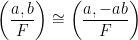 ,
, 
We can also rescale and to  and
and  to see that
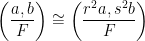
The equivalence  allows us to see that

So we can assume  to be representatives of the square classes
  . Also if we extend the scalars to field
  which has square roots of at least one and , the algebra will be isomorphic to
  or
or  both of which are equivalent to the matrix algebra
  Such a field is called splitting field of algebra.
For example, everything is a square in  , so
, so  is the only quaternion algebra over . Over reals, we have to just consider
  , and
, and  gives the Hamilton’s algebra
  and every other choice is of the form
  , so equivalent to
  But both the algebra when we extend the class become isomorphic to
  . That is
  and
and 
When  ,
,  is square
  and hence
Conjugates, Norm, Trace:
We have the conjugate map

And the norm

If the norm doesn’t represent zero non-trivially, then every non-zero element can be inverted.

Therefore every element satisfies a quadratic equation with coefficient in given by

We call  the trace. So pure quaternions with
  are the trace zero elements. Trace zero elements have squares which are in , in fact only non-scalar elements with squares in the field.
Thus we can think quaternions as an noncommutative analog of quadratic field extensions. In fact, the only quadratic division algebras (all elements satisfy degree at most equations) are the quaternions and quadratic field extensions. Division property is important because otherwise a lot degree 2 algebras exist.
Question: When do we get algebras which are not split, that is not isomorphic to ?
For instance if the norm form doesn’t represent zero, the algebra is a division algebra. So it cannot be the matrix algebra because the matrix algebra has zero divisors i.e.,  .
.
The quadratic form  is the norm form.
So if the form doesn’t represent zero, the algebra cannot be split. And It can also be seen that if this form represents zero non-trivially, the algebra is the matrix algebra.
Proof: If is square, the algebra is split. So assume is not a square and the norm represent zero, that is we have a non-trivial solution to  which implies that

Now check that  is a basis for the algebra with
  . This is a basis because the determinant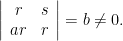
So the algebra is equivalent to 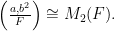
So we have two cases: Either
a) the algebra is a division algebra, doesn’t represent zero non-trivially.
b) The algebra is the matrix algebra .
We also consider the forms  and
and 
represents zero non-trivially iff represents zero non-trivially. And both the forms represent  non-trivially iff represent
Proof: One side is obvious. So assume has a non-trivial solution with  . Let
. Let  and consider
  orthogonal (with the bilinear form associated to the quadratic form) to the both
  and
and  . We have traces of
  and
and  both zero. Because
  , one of and is non-zero and we found a trace zero element with norm 0.
If we have a solution with  for the second form , we get
 , and we found a solution to
  . So we consider the case
  , so that we have non-trivial solution to
  . In this case
  and hence
  , which represents .
So either we have a split matrix algebra, or a division algebra. To check if it’s a division algebra, we have to understand the properties of these quadratic forms.
We finally see reason for the notation . The Hilbert symbol  equals iff represent , which happens if and only if the algebra is split, that is equal to .
Example: Consider  where is not a square
  . By the above discussion we need to check if
  has rational solutions. But a rational solution will imply that
  , which gives
  , and is not possible because
  For example if
  , then is not square which implies that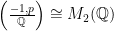
We saw the definining criterion for to be split matrix algebra. have solutions in . Some special cases where this happens are
1) Either of , is , or in general either of them is a square.
2) 
3) If  and
and  .
.
4)  (This is equivalent to , and hence the most general case)
Alternatively if we find  with
with  , then we have a division algebra.
Example: 1) The algebra  is a division algebra iff there is not sums of squares.
2) Any quaternion algebra over  for
for  odd is split. This is because
  and
and  as
as  vary have to intersect to give a solution to
  . ( both of them are of size
  )
)
Question: When are the algebras different (or the same)?
We saw some conditions on  for to be the matrix algebra, has to of the form
  . Similarly we
  and
and  is the same quaternion algebra iff
  . The matrix algebra corresponds to taking
  .
.
Thus scaling by an element of the form doesn’t change the algebra. Also two elements  and
and  different modulo the subgroup of elements of the form represent different quaternion algebras. To prove this we need to show there is a conjugation map
  on the to send
  to the basic element of satisfying
For example  ,
,  for
for  represents different quaternion algebras as because
  cannot be written as
  . So we have infinitely many distinct division algebras over
  !
!
The case of , we also other isomorphism between and  , and the quaternion algebra is determined by the discriminant.
 A Neighbourhood Of Infinity