The Ramanujan Tau function is defined by

The sequence 

Ramanujan observed multiplicativity property

And these both formulae together can be written as

Standard way to prove these properties by the use of Hecke operators.
By the Petersson trace formula applied to holomorphic cusp forms on 

where

is the Petersson norm of 

is the Kloosterman sum and the

is the Bessel function of first kind.
In particular we have,

This is an amazing formula, this complicated sum of Kloosterman sums twisted with Bessel functions turn out to be an integer! (up to the constants in the front)
Proof of multiplicativity:
We start by taking 

and compute 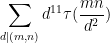
Comparing the expression for 


and

Note there is a change of variables 


The first equation is easy to check. The only way 

Let’s verify the second identity. It was proved by Selberg.
Proof of Selberg’s Identity:
In the case where 


And we are done in this case because the RHS has only one term corresponding to 


But it’s enough to assume 
Let 


Now if 


which implies 
If 


If 




Twisted multiplicativity allows us to reduce to the computations to prime powers. Because 


If 




So we can see that by reducing to the case of prime powers, the inner sum is zero when 


So we proved that
Next prove the Selberg identity for the case

The identity reduces to

If 

For instance if 


For 



which is obvious since each term in the sum on LHS repeats
We now move onto the general case. We basically use that
Let assume 

The RHS equals

Let us denote 
.

If 


So assume

By the twisted multiplicativity we get

We now use that 



So

We apply twisted multiplicativity in reverse to 


Now 


number of times and we see that 
 A Neighbourhood Of Infinity