Consider the sum

We want to prove lower bound on 
Consider the sieve weights

which have the property

The contribution from prime powers is small and we get

On the other hand opening up the sum over the divisors and switching sums we get,
 So we have

The contribution from  is
is  , therefore

 and partial summation with some smooth functions, we get the following



(The factor  is really important here, it cannot be improved with basic sieve estimates as above.)
Writing

and plugging in the above expression  for
for  , we get


So we have





Till now we did some elementary manipulations and estimates, and these equations are consistent with having primes concentrated in a few residue classes. In fact, as we will see later we have to somehow argue that they don’t all lie in the set  for the quadratic character. So the main problem of
  vanishing is still not really addressed. It’s equivalent to showing lower bounds on
  , that is we don’t want
  to behave like
  for most primes.
Selberg achieves it uses the following lemma.
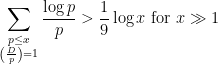
Main lemma: For every real, non-principal character  , for large enough
  , we have

There has to be some Class Number Formula kind of ideas to related the and the arithmetic of  (or binary quadratic forms of discriminant
  ) (In fact, all such ideas relate the information about point counting/size/archimedean behaviour of the forms to their multiplicative behaviour ie how they behave modulo primes.
Selberg consider the product
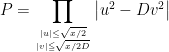
The product excludes term with  . It’s easy to see that
  . This is the archimedean part.
On the other hand, the contribution of a prime (in factorization) to the product depends on whether  or
or 

If , we need  and
and  to be divisible by
  and the exponent is
  exponent. On the other hand for , each solution
  satisfies
  for
for  any fixed solution. Thus we get
  for the contributions to the exponent of in this case.
Putting both the cases together we get,

and comparing with the lower bound, we attain

Finishing the proof:
Thus we have  is large for a a lot of residues
  because we get all primes by adding over all the residues . It’s large on average over residues with
  from the main lemma.
We want to say  is large. If it were small, then using
  , we get that there is a pair
  such that
  is large, and in fact each of the quantities
  is large because by
  we know neither of them can be too large alone. Using this information with can construct
  such that
  with
with  large.
(Proof: If there are more than  which are large, we can see that at least one pair of
  and
and  should be equal. If there are exactly number of
  large,
  forms a subgroup of index 2 inside
  and
and  is either
  for all
  or for all . The main lemma produced with and large, hence we see that all of the
  satisfy
  , and is large precisely for the subgroup of such that .This show that
  also lies in that subgroup and hence
  works)
Once we have using  we get
 is large.
 A Neighbourhood Of Infinity