Morley’s Trisector Theorem states that for any triangle, the three points of intersection of the adjacent angle trisectors form an equilateral triangle. Its beauty lies in the surprising emergence of a perfectly regular shape from an arbitrary starting triangle

Let’s first look at direct proof by trigonometric computations.
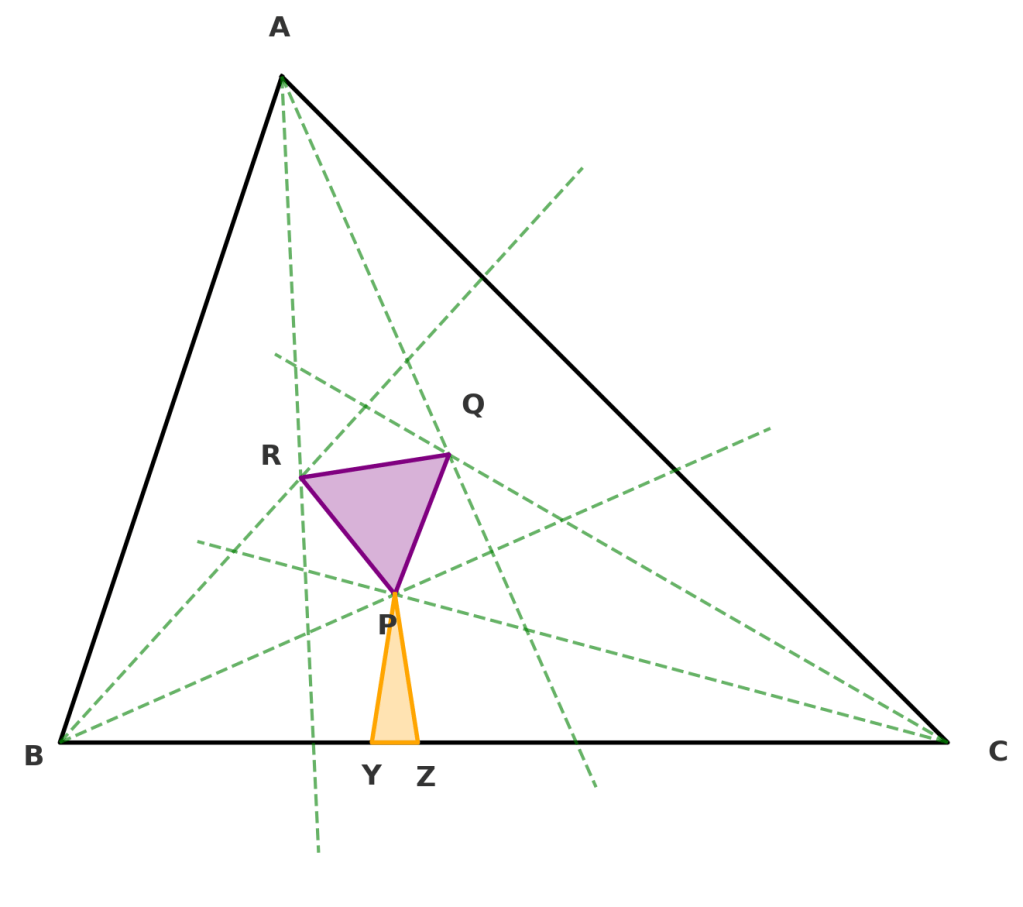
For a 


In 
Using the identity 
By symmetry, for segment 

In 

Substituting and factoring yields:
The expression in brackets corresponds to the Law of Cosines for a triangle with angles 

Thus, the side length is:
This expression is symmetric in 


![PR^2 = 64R^2\sin^2(\alpha)\sin^2(\gamma)\left[\sin^2(60^\circ+\alpha) + \sin^2(60^\circ+\gamma) - 2\sin(60^\circ+\alpha)\sin(60^\circ+\gamma)\cos(\beta)\right]](https://s0.wp.com/latex.php?latex=PR%5E2+%3D+64R%5E2%5Csin%5E2%28%5Calpha%29%5Csin%5E2%28%5Cgamma%29%5Cleft%5B%5Csin%5E2%2860%5E%5Ccirc%2B%5Calpha%29+%2B+%5Csin%5E2%2860%5E%5Ccirc%2B%5Cgamma%29+-+2%5Csin%2860%5E%5Ccirc%2B%5Calpha%29%5Csin%2860%5E%5Ccirc%2B%5Cgamma%29%5Ccos%28%5Cbeta%29%5Cright%5D+&bg=ffffff&fg=000000&s=0&c=20201002)


Conway’s Proof
Next we look at a famous proof by John Conway. Conway’s proof is elegant and clever. The proof is a masterpiece of constructive reasoning. Instead of dissecting the original triangle, Conway builds a new figure from seven “abstract” triangular puzzle pieces and shows that it must be similar to the original triangle.
The core idea is to define a set of seven triangles based on the angles of our given triangle. We then show that these seven pieces, when scaled and fitted together, form a perfect replica of the original triangle with its trisectors. Since the central piece of our puzzle is defined to be equilateral, the Morley triangle in the original must also be equilateral.
For a triangle with angles 

- The `Outer” Triangle (
,
, and
.
- The `Bridge” Triangle (
, and
.
The sizes of the pieces are fixed by setting key lengths to 1.
- The central Morley triangle,
, is equilateral with side length 1, so
.
- The outer triangle
with base angles
.
To prove 
This congruence ensures that the side 
Since this constructed figure is similar to the original triangle and its central piece (
Connes’ Proof:
The surprising regularity of the Morley triangle suggests a deep underlying symmetry. To reveal it, we need to change our perspective.
The core idea is to shift our focus from the objects (points and lines) to the transformations that define them. Instead of seeing the Morley vertices as mere intersections of trisector lines, Connes observe that we can view them as invariant points of certain rotations. This shift to the language of transformations and their invariants is where the magic lies.
Let the vertices of the triangle, 


The central observation is that the Morley triangle vertices—denoted by 

This identification turns the geometric puzzle into a question of algebra: do the expressions for
One approach is to compute everything directly. While effective in proving the result, it obscures the underlying reason the result holds.
First, we derive the explicit (and complex) formulas for

must hold, where 


This approach conclusively shows that Morley’s Theorem is true, but offers little insight into why it must be true.
Alain Connes realized that a heavy computation is unnecessary. Instead, one can reach the conclusion by examining the algebraic structure of the rotations themselves.
The key idea is a deep symmetry property among the rotations. If each rotation is applied three times in sequence, the result is the identity transformation. That is,

Why does this hold? Each map like 


This algebraic symmetry implies a geometric consequence, formalized by Connes’s abstract theorem. The theorem states that this symmetry condition is mathematically equivalent to a geometric configuration: the fixed points of the pairwise compositions must form an equilateral triangle.
To prove this, we consider three affine transformations of the form 
is equivalent to the geometric condition:

where 

The identity condition implies two things: the composite rotational part must be 1, and the translational part must be 0.
First, we examine the rotation. The rotational part of the composite map is the product of the individual rotations:

Setting 
Next, we examine the translational part. Denoting the total translation as 

Connes’s insight was to factor this expression. Using the explicit formulas for the fixed points:

we can rewrite

The pre-factor is nonzero under the assumption that none of the compositions degenerate into pure translations. Therefore, the translational part vanishes only when:
This is precisely the condition for
Since the Morley rotations 


 A Neighbourhood Of Infinity